Usha
Was in chennai for a niece's wedding. Itacted as an eye opener in many ways. The last wedding I attended was over 18 years ago. In the intervening years I had somehow imagined that people's attitude towards arranging marriages and celebrating weddings had changed a lot in keeping with the changing times. But I learnt a lot to the contrary in the 2 days.

Both the bride and the groom work in the U.S. and this was another reason I had assumed that the rituals would be restricted to the barest minimum. Actually, it turned out to be more elaborate than usual and included some of the events dispensed with in city weddings like the "vilayaadal"or "Nalangu"(which is mostly silly games and funny songs).I suppose staying so far away from Home makes people nostalgic for rituals and one is keener to preserve them than those who live with these on a daily basis. When I expressed this another cousin made a sharp observation that it is more for capturing it all for their video for their friends in the U.S rather than any deeper desire for preservation of anything. Well, whatever.People still do not mind having elaborate marriage ceremonies.

The expenses for the wedding are alarming and yet people want to do it no other way. A close relative gave me a figure of 10 lakhs as the minimum requirement for a "decent" wedding. And there is NO dowry involved - this is the expense for the wedding hall, food, the arrangements for the rituals, the dress and jewellery! When I asked why people did not prefer to have the wedding as a private affair in a temple and then have a reception which might bring down the expenses I was told "why must we do it hush hush when there is nothing to hide. The whole joy is to call everyone you know and have them come and wish the couple." That seems to be a million rupee decision. Still all the expenses are borne only by the bride's side!

Even though a lot of young boys and girls are working abroad, they seem to prefer to let the parents arrange the proposal. I do not know if they actually "prefer" it or it is the parents who want it this way. During the time I was at the wedding, I was approached by at least 3 mothers with girls in their early 20s who asked for my son's horoscope and some others asking me to suggest good girls for their sons. Apparently this is a normal activity at weddings - many alliances get initiated at weddings. They first ask you about yourself and then about your children and if they are impressed they broach the subject of horoscope exchange without wasting any time.

Girls are clear about what they want to do career wise ( engineering, then job at a particular company for 2 years and then M.B.A.) but they do not seem to mind marrying a guy that their parents find for them. There is still a strong preference for arranged marriages in spite of all that one hears on television and in films.

And the biggest revelation of it all was that the "girl seeing" ceremony - that is the visit by the boy and his parents to the girls house to meet the girl and her family once the horoscopes and photos have been matched - is still very much "on". The girl is no longer expected to fall at their feet and seek their blessings and she actually gets to talk alone with the boy for albeit a few minutes and the girl's opinion counts - these are the improvements from old times but still the practice is very much alive. Preethi has written a series of posts in her spot here on her personal experiences in this area. They are detailed and hilarious and when I see them from her prespective, the posts raise a lot of interesting points on how such methods still work in today's environment.

When I voiced my surprise at how nothing seems to have changed in the past 27 years since my own wedding I got the right answer from an aunt who said: "These have been preserved and handed down for the past thousands of years. And what makes you think they would have changed in 27 years?"
Usha
Headlines of newspapers scream day in and day out about the violence of people demanding their homeland or seeking a separate land for themselves. Suicide attacks, killing of innocent civilians, assassinations and verbal violence - wherever you turn the noise is deafening. Among all this bloodshed, there is a quite community of 6 million Tibetans who lost their homeland nearly 60 years ago to the aggression of their neighbour and have been forced to live in exile in other countries. They miss their land, their lifestyle and ther is alot of anger especially among the younger generations who have never seen their home. And yet all this youth energy and anger is controlled and they campaign to mobilise support for their cause. They do not even think of violence as an alternative. Their leader, winner of the Nobel peace prize, His Holiness the Dalai Lama, hopes to find a peaceful solution through negotiations.

A large number of Tibetans have been killed, their culture destroyed through demographic altreration by the settling of chinese in Tibet and reduction of Tibetan population caused by the exodus as well as genocide and sterilisations; their way of life has been destroyed through the destruction of monasteries and their environment denuded of its woods and minerals. A whole nation of people driven out of their homes, watching their home being looted and pulled down by the aggressor while being forced to live in foreign lands as guests.
They hope to go back to their home and to their own way of life some day - and yet they do not seek violence and armed struggle. They choose to fight peacefully.The Dalai Lama believes:
"In today's reality the only way of resolving differences is through dialogue and compromise, through human understanding and humility. We need to appreciate that genuine peace comes about through mutual understanding, respect and trust. Problems within human society should be solved in a humanitarian way, for which non-violence provides the proper approach."
To set an example to the rest of the world that peaceful means can still work and to probably change the language of violence all around the world, all peace loving people MUST raise their voice lending support to the Tibetan struggle for liberation.
A victory for Tibetans would be a victory for humanity, a victory for peace.

We talk about word power and thought power."Pen is mightier than the sword" and if we focus all our thought power, we could move even a stone without touching it. Let us try what we can with our word power. July 6th is "Bloggers for Tibet day" and it is also "World Tibet Day". Please blog for the cause of Tibetans, please blog for what is right, Please blog for peaceful means for solving problems. Please blog to help the Tibetans have their home back.
Usha
Recently a Lt.General in the Indian army came under a lot of negative publicity for his remarks about women in the army. It is possible that he had good reasons for his statement besides being purely male chauvinistic but in today’s time and age, you do not make such statements publicly without explaining or qualifying. A combat role in the army is very hard because of the demands it makes on one’s physique, rough and unfriendly terrains and finally the emotional demands– not something easy for men either but I suppose if there are women willing to enter such roles without claiming any special treatment, they should have the opportunity to do so.

When one sees the quickness with which women today challenge such statements and want to assert their equality everywhere, one wonders why this was not the case even 50 years ago – how did they accept a decidedly inferior role for themselves in life and be content with staying in the shadows. I remember discussing this with a friend’s grandmother – she was a graduate, well read, well-travelled and very insightful. She told us that in those days there was a different kind of equality – the clear demarcation of roles depending on a perception of who was better suited to do had no values attached to the different roles. There was no inferiority associated with home making and child rearing which were left to women while men worked to put the bread on the table. They made all important decisions together as equal partners. Neither felt any threat from the other – so there was no need for enforceable laws and rights as it was the unwritten norm in society.

I remembered this conversation while reading “Almost French” by Sarah Turnbull which is a very interesting and amusing narrative by an Australian living in Paris on the cultural differences. She writes:
"France may be famous for feminists such as jean d’Arc and Simone de Beauvoir but the notion of “feminism” is scorned in this country by both sexes. Despite the French penchant for revolution, reforms for women have occurred through slow evolution, and generally later than other developed countries. Incredibly, French women didn’t get their vote until 19444, more than forty years after laws were passed in Australia and New Zealand and almost three decades after Canada and Britain. Until the mid sixties they had to have their husband’s permission to obtain a passport or even open bank account, and their property and family right s were severely restricted.
It is not that other countries do not have issues to resolve concerning women – take a look at Australia where paid maternity leave is almost non- existent and the number of women in senior management remains negligible. But the situation in France is intriguing.
Attempting to explain the absence of women in French Politics, an Ex Justice minister says:
“The very specific history of France, which excludes women from Political role while granting them a well recognized place in society….has created a unique situation between the sexes,” she writes. “if women have not felt totally inferior, it is because their right to speak out has been consistently recognized., bringing them a certain role and power.”
In other words, if French women have not fought for their rights, it is because they have traditionally been treated with respect. If women haven’t shown anger toward men, it is because in this country there is no simmering male anger toward women either.”

I know this may seem repetitive as we had quite a lively exchange of ideas on similar issues after my recent post on women's issues and it made me think of this further.I think in India the unfavourable tilt in the balance of power happened when they stopped educating women on the assumption that they did not need it for fulfilling their traditional roles. With this, informed decision making automatically became a male domain. And when the job of bread winning meant going out to work and not merely on your farm or by practising the family profession, earning money became superior to the traditionally ‘feminine” roles. Deprived of Education women could not enter this arena and this resulted in opportunities for subjugation of women and women were not equipped enough to counter the overt and covert forms of submission. It took a whole movement to be born and they had to organise themselves and fight for "rights" and "equality" in a concerted fashion. Happily all this has changed in the past 50 years. At least in theory there are laws to ensure equality. But in spite of all the rights and laws in existence, nobody can “make” anyone feel “equal” to another. This has to come from within. Every girl should feel that she is no less than any other person whatever she is told.
Another reason for this post is this excellent post by The Rational Fool here where he talks about the challenges before every girl of today in becoming her own person- the historical and social blocks to be overcome and the determination to march on with a focus to live her life as a person in her own right and not be stereo typed into a traditional female role. I believe every girl must do it not only for herself but to be an example and inspiration for her less informed sisters and for the future generations.
Labels: 8 comments | | edit post
Usha
Children in the U.K. will be asked to work out the speed and distance sums by using examples from football and the speed and the distance of the ball that Beckam kicked to the goal. This is part of the GBP 4 million campaign to make mathematics more interesting for children.
Very interesting!! I am all for any effort that makes these speed sums interesting for children.
I have traumatic memories of speed related sums from my school days that have left me permanently scarred. There were this particular genre of sums where the tap was filling a tank at a certain rate of x litres per second and there was this horrible person who was draining the water at the rate of y litres per second and we had to calculate how much time it would take for the tank of a certain capacity to be filled. Every time I am faced with a situation of water scarcity, I have a desire to seek out these water drainers and decapitate them - for spoilng my arithmetic classes as well as being the single large cause of all the global water problem.

My math teacher had a particular penchant for making our lives miserable with such problems. Another of her favourites was:
The population of town A is 4800 more than town B. If 3100 people move from town B to town A, the population in town A will be 11 times that of town B. Find the original total population of the two towns.
Faced with this problem, some of my wizard colleagues would plunge into the problem and be ready in a minute with the answer and as a bonus huge smiles. While my mind would want more data such as "why were they migrating?" "was there an epidemic?' "in which case, what about the reduction in population because of the people dying?" "What about births during the period of migration?" etc...But since i could not muster enough courage to ask the teacher to furnish all the required information, I scribbled the answer 976 3/4 and was sent out of class for being inattentive and trying to act smart! Our educational system kills all creativity, don't you see?

I think it is important to make a child relate these numbers and calculations to reality to evoke interest and make it seem more than mere numbers and additions and subtractions.
Imagine giving the following problem to a child of today:
You are traveling 40 Km/h over a bridge that is 4260 ft. long. How long does it take to cross the bridge?
Wouldn't a smart child in bangalore immediately wonder about other dependencies such as traffic jams? Isn't unfair to let the child out into the big bad world thinking that distance and speed are the only factors involved in assessing the time required to travel between point A to point B.After all , is it not the primary goal of education to prepare a child for the world?
We need to make sums sound more real and true to life to see the real life application.
Sometimes you wonder if mathematicians are people who are so absorbed in numbers that they forget the human element to life. take this problem for example:
Two trains 200 miles apart are moving toward each other; each one is going at a speed of 50 miles per hour. A fly starting on the front of one of them flies back and forth between them at a rate of 75 miles per hour. It does this until the trains collide and crush the fly to death. What is the total distance the fly has flown?

Excuse me, we are talking of a major collision here causing a few hundred deaths perhaps. Who cares about the distance the fly has flown? Sympathetic though I am to the preservation of the earth's fauna, I think that hyperactive, maniacal freak of a fly deserved to die for running between the trains.Wonder if he caused the collision by distracting the drivers with his constant flight!

P.S.: Hehehe. there , that felt really good! My sweet revenge for all the knuckle raps that I suffered at school for being so numerically challenged.
I actually have great respect for mathematics and mathematicians - no offence intended. But I really used to find some of these sums highly amusing.
Usha
As a nation I think we are not a very demonstrative people particularly of emotions of love and affection.While we may jump and scream during a cricket match and express our joy and anger, when it comes to showing love and affection we tend to underplay and even suppress.Most Europeans and even in America, it is common to greet each other with a peck on the cheek, a hug or a half hug. But in india, most of us shy from being touchy-feely and demonstrative. It is not difficult to understand it as in our culture physical contact was restricted to family - in south India,a brother is not allowed to touch a grown up sister, leave alone hug and plant a kiss. With a lot of people travelling and with the western influence on our life style, things are changing.
One sees a lot of it in the Hindi film fraternity and among the college students. Actually it feels quite good when many of the younger girls in the french class spontaneously greet you with a hug. It does seem therapeutic and may be there is some truth in the famous treatment technique of Munnabhai m.b.b.s. - the jadoo ka jhappi treatment. According to a family therapist Virginia Satir "We need 4 hugs a day for survival. We need 8 hugs a day for maintenance. We need 12 hugs a day for growth!"
Next time you find someone close in a sad or low mood, try giving them a hug and see the difference. If you love someone or care about someone, it is ok to express it - it does not make you weak or vulnerable.
Apparently hug can be an effective neutraliser of anger. Walter Anderson says
"If you're angry at a loved one, hug that person. And mean it. You may not want to hug - which is all the more reason to do so. It's hard to stay angry when someone shows they love you, and that's precisely what happens when we hug each other."
Kids know this instinctively. The moment they sense that you are angry, upset or sad they give you a hug and make you feel better.
This article has some interesting information on the importance of hugs as a therapy.
And next time you meet a friend but did not have the time to buy a gift remember this:
“A hug is the perfect gift; one size fits all, and nobody minds if you exchange it.”
Usha
Anita nair had written a nice article in the New Indian Express on father's day. I always get very interested when people talk about their relationship with their father, the jokes and pranks they shared, their discussions,arguments etc. In our family, we knew our father only through my mother. He hardly spoke to us and if we needed anything mother conveyed it to him and it was either approved or rejected. No further appeal. He was not someone who was ever worried about our academic performance - perhaps because we were all inevitably at the top of the class but i have a nagging feeling that he would have signed our report card without a murmur even if we had got the last rank in class. I do not remember him ever giving us advice or opinion on anything - he might have if we had asked him but we were too scared to talk to him directly. And it was always a joke to me when my mother claimed that I was my father's favorite - i wish he had shown it to me in some ways! It was only after my marriage that I experienced tangibly a father's love through my father in law who treated me more like his own daughter.

With this kind of emotional baggage, I always feel a tug somewhere inside when I come across special father /children bonds in books and films.Needless to say that I have my own set of favourite fictional fathers:

At the very top of the list of course is daddy "Mrs.Doubtfire"- doting and full of fun, a buddy above all- someone who makes you feel "no matter what, I will always be there for you." He could get you in trouble, lots of it but you know he will also get you out of it. A great dad for pre-adoloscents.

Almost rubbing shoulders with daddy doubtfire is the daddy played by Gregory Peck in "To Kill a Mockingbird" - a daddy whom every child would be proud of. A little too perfect? May be, but who's complaining?

Mr.Bennett of Pride and Prejudice is another favourite. He was perhaps a failure in a conventional way in terms of securing a sound financial future for his daughters and that is precisely what makes him more human than the other fictional fathers. He is not a super hero. He is an ordinary father whom you could actually hope to have - well-read,one with whom one can discuss anything under the sun, share a good joke with and one who would support you in any rational decision you make. A great father in your teens and adulthood.

The role of "daddy" played by Anupam Kher in the Hindi film of the same name is another favourite - an immensely talented poet. oozing sentmentality from every pore, weak in many ways but I just love the way he looks at his daughter - as if his world started and ended there.

I love another father's role he played in "Dil Hai ki maanta nahin" - super rich and super crazy. Now that is a fun father who would indulge your every whim and if you are equally crazy, the world can't get better. I particularly loved the last scene when he incites Pooja to elope with Aamir in stead of the rich boy who is about to marry her and the way he gleefully announces after she runs away: "She has a habit of running away and she has done it again!"

The only Father/ daughter duo I could remember from Tamil films is the one in Rajaraja chozhan played by Shivaji Ganeshan and Lakshmi - very interesting interaction between a smart father and daughter. The daughter worships the father and the father adores the daughter but neither could be bothered to make a show of it and have to constantly engage in verbal battle and one-up-manship in witty exchanges. Very interesting portrayal.

Of the ad dads, my favorite would have to be the father in the Nokia cell phone ad which goes "Na Badla woh suraj woh rah, Na badle mere papa." In the one minute you see the special bond between father and son and their expressions are lovely - a father who takes special care to instil the right values in his children and show them the right path ahead and would stay down to earth to insist that the function of a phone is to simply talk to someone!

And finally of course I know for most of you who read this your favourite daddy is your own - So don't wait for a special day to let him know that - Now is always a good time!
Usha
Saw two films in the past few days - both left me thinking about women and their life and psyche just about 100 years ago.

The first was a french film "Camille Claudel" - based on the life of Camille, who was the pupil of Auguste Rodin, the French sculptor who attained immortality through his carving of "le Penseur"(the thinker). She was so talented and inspired in her work that she became his muse, his model and collaborator for some his best works. They had a passionate relationship which ended when she realised he would never leave Rose Beuret,his partner of 20 years. In the subsequent years she created a lot of work which showed her genius and originality but she never got over Rodin and slowly became alcoholic, depressed and paranoid. In her destructive phase she destroyed much of her work and finally had to be confined to an asylum where she lived for 30 years till her death in 1943.
A woman with immense talent, a rebel but destroyed by the her love for a man and his refusal to marry her.So much genius, so gifted but all to no end - what an immense loss to the world of art. What was the reason - love too strong or inability to accept rejection? Did she value herself only in relation to Rodin that she went on a path of destruction wheh he refused to marry her?

The second was "Memoirs of a geisha" - the story of a young girl who is sold by her parents to a okiya or a geisha house , her initial resistance and struggles and gradual transformation into acceptance of her life and its culmination in her becoming the finest geisha in town. It could have easily slipped into a documentary but for the emotional interplays involving jealousy, love and sacrifice. Nice and touching film.

What struck me was the concept of "geisha" - women who were trained in everything beautiful, artistic, gentle and doing and saying things in the right manner- whether it was pouring sake or discussing politics.At a time when wives were excluded from public life, geisha women were employed to be hostesses at social gatherings as they were trained in the skills that symbolised society's illusion of feminine perfection. Obviously such perfection can never been attained in a "real" relationship as with a man and his wife. The reality of day to day living tends to complicate life and brings out the rougher and ruder side of men and the nagging, sulking and meaner side from the woman. Real life is after all not perfect. That is where the Geisha's came in - as a periodic escape into a make-believe world where everything was beautiful, gentle and perfect. An escape into a fantasy world which cost a packet to the man in terms of maintaining the Geisha and for the woman , the cost was that she could never have the status of a wife. A classic case of commodification of women and yet a lot of women chose the profession and took pride in being the best Geisha.

Two types of women - exact opposites in terms of personality! Of course it is true that neither type of women represented the "typical" or average woman of their age. But until very recently women were expected to possess certain attributes as defined by a man's conception of what was "desirable" in a woman and this played a large role in their upbringing. "Rejection" affected them.
What is comforting is that most of the young women of today can relate to neither type of women - shows the distance we have covered in terms of advancement of women. Men and marriage have ceased to be the point of reference for what they choose to do with their life. Their life is much larger than these.
Or is it?
Usha
The Income Tax forms to be submitted in the coming years will collect information on the spending details of the assessees. When I read this I wondered if the Finance Minister was trying to understand the soul of the assesees as I had read somewhere:
"How you make your money is unimportant;how you spend it reveals your soul."
I suppose the FM today is such a harried man that he has no such desires but yes, the spending habits of a person or family speak a lot about them. The FM himself is a personally wealthy man with simple and refined tastes and then we have men like Narayanamoorthy on whom their enormous fortune sits lightly. Makes you realise that beyond what you can spend in a lifetime, your bank balance is just a number.
As one looks around and sees the salaries offered for fresh engineers and MBAs you realise that the problem for many today is not "how to Make money" but "how to spend it well."I guess that is where the lifestyle magazines come to one's aid - showcasing exclusive products designed to announce your "arrival" to the world. Watches costing lakhs, designer jewellery, cars oozing machohood and diamonds enhancing one's self esteem.
I suppose the first impulse we all have when we get our financial independence is to splurge on things we have always wanted but not allowed to have. Most of the time these attractions lose their charm once we have the ability to acquire them anytime. So it would seem that the trick would be to set one's desires so high that you would always be a little short of the ability to have it, and this will keep you stay motivated to make more money. I know a few friends who support a lot of causes and this give them the motivation to earn - the desire to help the needy. But on the average, I suppose most people make money to have comfort, security in old age, a certain level of luxury and indulgence and their spending patterns reveal these motivations which revolve more around themselves and their family than any cause or person beyond. Not a bad motivation to have - at least they are not a burden to anyone. What I cannot understand is people who spend so much time and energy making money and having no time or interests to spend it. And then there are these others who make money in corrupt ways that spending it or even keeping it becomes a problem - they have to create secret storages in their house floors or their children use currency notes to smoke cocaine.
I suppose money well spent is an indicator of a life well-spent.
But I think the problem with running after making money is the question :"how much is enough?" Tough question. But I think for me , "enough" would be when I can give my children nutritious food and good education,buy the books and music I want,not have to think twice about inviting someone to share my meals,indulging in something silly once in a while, and being able to lead my simple life independently without becoming a burden to anyone till the end.
Isn't that enough?
Usha
Traffic in Bangalore tops the list of my pet peeves. I can claim to have some experience on the subject having had the experience of driving 28km each way from IIM to peenya every single working day for 3 years and that practically covers a diagonal sweep from southeast to northwest ends of bangalore (in the early 90s - now bangalore has stretched beyond in both directions)
And I have spent another 20 years driving around town to different workplaces and so I can speak about it with some authority. But one can sum up Bangalore traffic today in one word:CRAZY! and add a statutory warning: KEEP AWAY!
So it was highly cathartic to read a hilarious article forwarded by Ramkumar on the condition of Indian traffic and pretty spot on. Thanks Ram. I agree ,there is no calamity so great that you cannot laugh about it!
This hilarious article was written by a Dutchman who spent two years in Bangalore, India, as a visiting expert
Driving in Bangalore / India
"For the benefit of every Tom, Dick and Harry visiting India and daring to drive on Indian roads, I am offering a few hints for survival. They are applicable to every place in India except Bihar, where life outside a vehicle is only marginally safer.
Indian road rules broadly operate within the domain of karma where you do your best, and leave the results to your insurance company.
The hints are as follows: Do we drive on the left or right of the road? The answer is "both". Basically you start on the left of the road, unless it is occupied. In that case, go to the right, unless that is also occupied. Then proceed by occupying the next available gap, as in chess. Just trust your instincts, ascertain the direction, and proceed. Adherence to road rules leads to much misery and occasional fatality. Most drivers don't drive, but just aim their vehicles in the generally intended direction.
Don't you get discouraged or underestimate yourself except for a belief in reincarnation; the other drivers are not in any better position.
Don't stop at pedestrian crossings just because some fool wants to cross the road. You may do so only if you enjoy being bumped in the back.
Pedestrians have been strictly instructed to cross only when traffic is moving slowly or has come to a dead stop because some minister is in town.
Still some idiot may try to wade across, but then, let us not talk ill of the dead.
Blowing your horn is not a sign of protest as in some countries. We horn to express joy, resentment, frustration, romance and bare lust (two brisk blasts), or just mobilize a dozing cow in the middle of the bazaar.
Keep informative books in the glove compartment. You may read them during traffic jams, while awaiting the chief minister's motorcade, or waiting for the rainwater to recede when over ground traffic meets underground drainage.
Occasionally you might see what looks like a UFO with blinking colored lights and weird sounds emanating from within. This is an illuminated bus, full of happy pilgrims singing bhajans. These pilgrims go at breakneck speed, seeking contact with the Almighty, often meeting with success.
Auto Rickshaw (Baby Taxi): The result of a collision between a rickshaw and an automobile, this three-wheeled vehicle works on an external combustion engine that runs on a mixture of kerosene oil and creosote.This triangular vehicle carries iron rods, gas cylinders or passengers three times its weight and dimension, at an unspecified fare. After careful geometric calculations, children are folded and packed into these auto rickshaws until some children in the periphery are not in contact with the vehicle at all. Then their school bags are pushed into the microscopic gaps all round so those minor collisions with other vehicles on the road cause no permanent damage. Of course, the peripheral children are charged half the fare and also learn Newton's laws of motion enroute to school.
Auto-rickshaw drivers follow the road rules depicted in the film BenHur, and are licensed to irritate.
Mopeds: The moped looks like an oil tin on wheels and makes noise like an electric shaver. It runs 30 miles on a teaspoon of petrol and travels at break-bottom speed. As the sides of the road are too rough for a ride, the moped drivers tend to drive in the middle of the road; they would rather drive under heavier vehicles instead of around them and are often "mopped" off the tarmac.
Leaning Tower of Passes: Most bus passengers are given free passes and during rush hours, there is absolute mayhem. There are passengers hanging off other passengers, who in turn hang off the railings and the overloaded bus leans dangerously, defying laws of gravity but obeying laws of surface tension. As drivers get paid for overload (so many Rupees per kg of passenger), no questions are ever asked. Steer clear of these buses by a width of three passengers.
One-way Street: These boards are put up by traffic people to add jest in their otherwise drab lives. Don't stick to the literal meaning and proceed in one direction. In metaphysical terms, it means that you cannot proceed in two directions at once. So drive as you like, in reverse throughout, if you are the fussy type.
Least I sound hypercritical, I must add a positive point also. Rash and fast driving in residential areas has been prevented by providing a "speed breaker"; two for each house. This mound, incidentally, covers the water and drainage pipes for that residence and is left untarred for easy identification by the corporation authorities, should they want to recover the pipe for year-end accounting.

Night driving on Indian roads can be an exhilarating experience for those with the mental make up of Genghis Khan. In a way, it is like playing Russian roulette, because you do not know who amongst the drivers is loaded. What looks like premature dawn on the horizon turns out to be a truck attempting a speed record. On encountering it, just pull partly into the field adjoining the road until the phenomenon passes.

Our roads do not have shoulders, but occasional boulders. Do not blink your lights expecting reciprocation. The only dim thing in the truck is the driver, and with the peg of illicit arrack (alcohol) he has had at the last stop, his total cerebral functions add up to little more than a naught. Truck drivers are the James Bonds of India, and are licensed
to kill. Often you may encounter a single powerful beam of light about six feet above the ground. This is not a super motorbike, but a truck approaching you with a single light on, usually the left one. It could be the right one, but never get too close to investigate. You may prove your point posthumously."
Usha
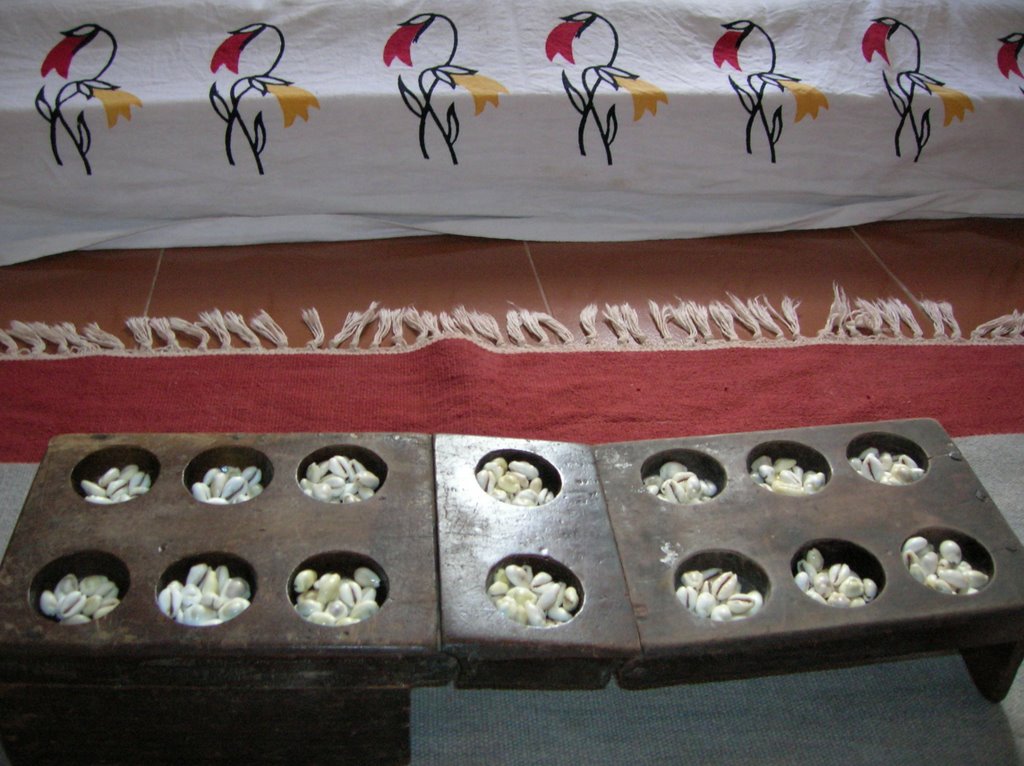
If you were born after the 70s and lived in one of the cities all your life, it is very likely that you do not know what Pallankuzhi is. But those older, especially from the smaller towns of South India may have spent many summer afternoons in endless rounds of this game. Remember this?


The kit for the game was no more than this wooden plank with 14 holes and 144 to 170 cowrie shells ( sozhi).
The game did involve some calculations while each player tried his best to capture all the sozhis and defeat the other players.It was a little like life itself - At the start of the game eveyone gets the same number of sozhis and what you made of it later was purely left to yourself and chance.Sometimes you were nearly bankrupt and then ended with a windfall ( in the form of getting access to the central hole called the Kasi) However careful you were in your calculations,chance did play a part and you ended up losing. For example the first player had some advantages in some settings and when a player did not have enough for all the holes on his side, the holes he chose to leave empty had a role to play. There were variations of the game depending on the age groups differing in degrees of difficulty.

The above is a 60 year old pallankuzhi plank with me and when my fingers need some exercise I do play solitaire version of it. My grandmother used to play against herself and every hand she played she played to win.And I am sure it was a good exercise for her hands and mind and perhaps a defense against Alzheimer's and the like.She lived to be 90, alert and active.

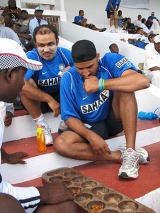
So you can imagine my delight when I saw THIS
"warmed the cockles of my heart!" as Bertram Wooster would have said. And indeed it did exactly that. I am reproducing it here for your convenience:

"A Game of Warri"


"Harbhajan Singh wracks his brains over a game of Warri, a pastime that the locals introduce him to. Warri is played in India as well – it's known as Pallanguzhi in Tamil – but, going by the mystified looks, none of the Indians seemed to have heard of it."

"If you have mastered Warri, you earn the title of "professor". One such professor decided to give Harbhajan a lesson, teaching him the intricacies of the game. A Warri board comprises twelve large pockets, into which 48 beads are filled equally. The player who begins empties one of the pits that belongs to him and distributes the seeds - one for each pit in a clockwise direction. He continues the process by emptying the pit next to where he ends the first set of seeds. He carries on the process until the end, when if he finds more than one empty pit, he gives up the turn to the other player. If he finds one empty pit next to the pit where he ended, then he captures all the seeds gathered on the right side of the empty pit. The player who captures the most seeds ends up the winner."

"Quick counting of the beads and judgement of the number of pockets to be filled requires one to be very attentive. It also requires some rapid mental calculations. Harbhajan does well, plays a few smart moves and thrills "professor" with his learning curve. Inevitably he loses, but the margin (25 to 23) tells you how close it got. "Professor" challenges him for one more round. Harbhajan, though, has a valid excuse: "I need to go out to bat, wickets are falling quickly."
Posted by Siddhartha Vaidyanathan
http://blogs.cricinfo.com/tourdiaries/archives/2006/06/a_game_of_warri.php#more

Pallankuzhi-warri championship trophy - any sponsors???
Usha
We have this talk in our family once every two years when one of the cousins working in the U.S.A. comes down for a customary 4 week trip to india. (They use every alternate year's leave to visit "home" and the other years to take a vacation in Europe or some tourist destination). They do miss home,the food, the people, the festivals, the language, the concerts but when asked if they want to return for good they are not sure. They worry about the "Quality of life" - the work culture, the discriminations,the traffic, the power cuts, difficulties in dealing with government, lack of respect for others' rights, struggle to get law enforced, the pollution and the lack of recognition of merit. Once we have this conversation, it makes you wonder how you are actually surviving in this jungle and managing to be happy most of the time.
Well, I do not blame them. they have a choice and certainly the grass is greener on the other side. Their daily life is easier there and their children have better chances there. I suppose they should just stop discussing their vague ideas of returning for such discussions only end up highlighting the difficulties of living in India which we do not seem to notice so much and take in our stride and adjust ourselves to until they are pointed out to us.

"Clive Avenue" by T.S.Tirumurthi is a very interesting portrayal of the issues that educated, upper middle class Indians families face. The characters, their beliefs, the issues confronting them, the dilemmas they face are all very very familiar. You recognise them and relate to them so well including the language used that it could be one's own family that he is talking about. Parents clinging to their roots trying to preserve their lifestyle and principles but still having their life invaded by a fast growing culture of corruption, blackmail and violence.The younger generation disillusioned and defeated by the system and trying to opt out. Amusing and interesting conversations, their superstitions, the regional quirks and idiosyncrasies, the changes that the city of chennai has faced during the life of 2 generations in which it has transformed from a quiet, orthodox city to a flamboyant, noisy,cosmopolitan metropolis. The narration is very interesting and absorbing. The conversations and usages are totally familiar to someone from the same background as the milieu in which the novel is set. Very interesting read and raises some very pertinent questions on the current plight, the choices before them and the future of Tamil brahmins in Tamilnadu- perhaps not just the brahmins but most forward classes.

The author is a counsellor at the Embassy of India in Washington DC. While reading the book it felt similar to the feeling that one gets while reading "Malgudi days" and some other books by R.K.Narayan - the delineation of true to life characters, the language the characters speak and the unfolding of the story through normal day to day incidents and the subtle humour that runs through the narrative through the simple contradictions in human nature. After finishing the book I read the acknowledgements and it seems that the author is the nephew of the great R.K. Narayan.
Usha
As a five year old if he had been asked what he would have wanted to do on his 25th birthday, he would have said " I want to be in some cricketing nation like west Indies, preferably spending time with some cricketer." And that is precisely what Siddhartha was doing yesterday on his 25th birthday - spending the day in Antigua being driven around, treated to good food and taken to a few of the 365 beaches in the country - his escort was Winston Benjamin, ex-player on the W.Indies team. And Benjamin did not even know that it was his birthday!
Siddhartha is having a great time in the West Indies for the past fortnight and he is recording his impressions in the tour diary.
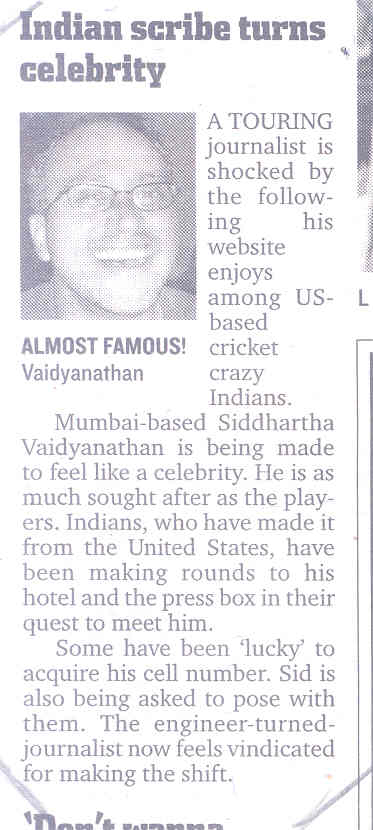
And then comes another birthday surprise. Another journalist from Midday, Sanjeev Samyal, is struck by the number of visitors who come to meet siddhartha and the calls he receives from cricket fans and he decides to make a news item of it thoroughly embarassing him. I invoke a mother's privelege to be shameless when it comes to bragging about her children and here I go:


Happy birthday Siddhu! Hope all your dreams come true in the years to come!!
Usha
Last month when I spoke to her parents, we spoke of her as the "little one".
-"How's the little one?" I asked
-"oh as playful as ever. We still do not know when she will get serious about her studies or anything" replied her mother.
- "It is alright" I said indulgently, for this is a child I had known from birth and loved like my own. I said, "let her take her time to grow up. There is always the time to take life seriously."
And you can imagine the scene among her family and friends when the "child" decided to get married at 19 to someone who seemed to be entirely different from everything her family believed in.
Her parents cannot figure out where they went "wrong". From their birth the children have been handled as projects and every detail worked out meticulously, the best environment provided in every way and nurtured with sensitivity and care. The parents practised every value they wanted imparted to the kids. Nothing was wanting, in love or materially. And yet, the child-woman chose to do something like this.They cannot explain it. they do not know how to set the wrong right because they do not know what went wrong from their side. Enquiries revealed that there was nothing striking or spectacular about the boy - he is just an "ordinary, mediocre 28 year old from an ordinary, mediocre family". And yet he could motivate her to severe ties with everything and everyone she had known and loved in these past 19 years? Or was the ordinariness itself the motivation - having felt suffocated among "super-achievers" that was the norm in the parental house?
The parents simply cannot stop looking for the "why" of it and feeling somehow that they have failed.
I feel it is time the parents stopped trying to find the possible causes for her behaviour and blaming themselves. Every child is an individual and not just a product of upbringing. Give them love and a good environment to grow in - beyond that what they make of their life is their own choice. There is no point trying to control it nor seing their life as extension of your own.Every parent knows how tough it is to develop such a detachment towards their child particularly when they go through pain. But I guess life is something each one has to live on their own and learn and cannot be done through a manual of instructions developed by someone else!
Usha


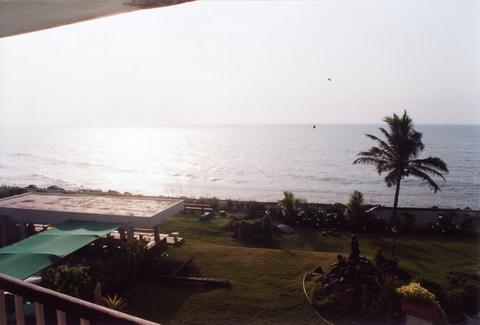
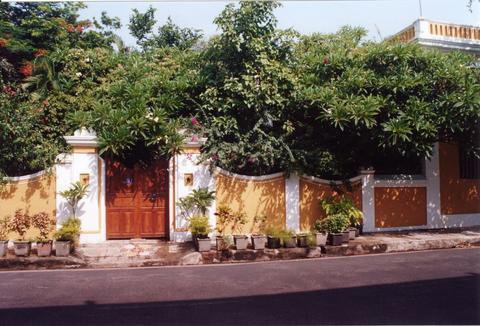
Spent the weekend in Pondicherry. Could not help being charmed by the architecture and the odd blend of French and Tamil culture and the peace that one felt as soon as one was inside the Ashram. All this in spite of the merciles heat against which the sea breeze was powerless.And yet no one seemed to notice it except us. Made one wonder if the heat was just a state of mind or was it really that hot?


Another thing that I always find in coastal places and islands is the attitude to time. On the day we arrived, when we tried to draw up the schedule for the day Priyamvada, who is from Pondicherry, told us that the motto in pondicherry is to "take your time with time" and not to hurry about the day. I have seen the same in Goa, Mauritius, Maldives and Srilanka too. They seem to ignore the clock and go more by the calendar.Perhaps they go by the bigger picture that Life is too large to be split into minutes and seconds and worried about.Generally they are happy with what they have, do not fret too much and exhibit a great resilience to hardship and suffering.They do not brood too much and bounce back quite easily. Does the sea teach them that?


On another note, how come the same is not true of places like Chennai or Mumbai which are bordered by the sea too?
Usha
Are you,like me, put off by the sheer number of implements placed on a dinner table at formal parties or high class restaurants? Do you lose your appetite when you are forbidden to eat with your fingers? Are you from a culture that believes in tasting food and expressing appreciation of it audibly and visibly? Do you crave to lick your fingers after a nice spicy meal?

Then you will love this delicious piece from "The importance of Living by Lin Yutang:

"The Chinese idea of happiness is,as I have noted elsewhere, being "warm, well filled, dark and sweet"- referring to the condition of going to bed after a good supper. It is for this reason that a Chinese poet says, "A well filled stomach is indeed a great thing; all else is luxury." With this philosophy.therefore, the Chinese have no prudery about food, or about eating with gusto. When a chinese drinks a mouthful of good soup, he gives a hearty smack. Of course, that would be bad table manners in the West. on the other hand, I strongly suspect that Western table manners, compelling us to sip our soup noiselessly and eat our food quietly with the least expression of enjoyment, are the true reason for the arrested development of the art of cuisine. Why do the Westerners talk so softly and look so miserable and decent and respectable at their meals? Most Americans haven't got the good sense to take a chicken drumstick in their hand and chew it clean, b ut continue to pretend to play at it with a knife and fork, feeling utterly miserable and afraid to say a thing about it. This is criminal when the chicken is really good. As for the so-called table manners, I feel sure that the child gets his first initiation into the sorrows of this life when his mother forbids him to smack his lips. Such is humn psychology that if we don't express our joy, we soon cease to feel it even, and then follow dyspepsia, melancholia, neurasthenia and all the mental ailments peculiar to the adult life. One ought to imitate the French and sigh an "Ah!" when the waiter brings a good veal cutlet, and makes a sheer animal grunt like "Ummm!" after tasting the first mouthful. What shame is there in enjoying one's food, what shame in having a normal, healthy appetite? No, the chinese are different. They have bad table manners, but great enjoyment of a feast."

The Chinese seem to have their priorities right much like the members of the clan I come from. The enjoyment of the meal begins in our household even before the meal is cooked. The women discuss the menu and the right accompaniments to each dish . (Paruppu usili has to have morkozhambu and not any other sambar) and then the preparation is done with great care. After serving the meal, the person tasting the food is carefully watched for spontaneous reactions and then the women feel elated. They must be High-fiving each other in the kitchen out of excitement. On the contrary, if the food is eaten in total silence that is taken as a failure and the women folk spend the rest of the day depressed. And greater and greater care goes into the cooking until some visible , audible appreciation is elicited and then they feel that their existence is justified! I guess this is a value that one no longer associates with current generations who are more into fast food and spoon and tissue culture. What a colossal loss!
Usha
When I list the values and principles that are most important to me even today, I realise that most of them were formed in my adoloscence. These were not given as abstract ideals to be followed but one saw them in the personality of people one interacted with - mostly the teachers and friends in high school and close family members. I look around and find that today schools have become more like very efficient training grounds in the various fields of knowledge;Caught in this hectic process,overloaded teachers have no time to concentrate on character building. This void is clearly seen when one comes across phenomenal blunders of high performers - to quote a recent example, Kavya Vishwanathan.
Parents are equally to blame as their expectation from the school is to make their child worthy of IITs and IIMs or any highly paid profession. Perhaps it is time every parent read the mail that Abraham Lincoln sent to his son's headmaster and see if their child is being given an environment where he can imbibe these timeless values:

"He will have to learn. I know that all men are not just and all men are not true. But teach him also that for every scoundrel there is a hero; that for every selfish politician there is a dedicated leader. Teach him that for every enemy there is a friend. It will take him, I know, but teach him, if you can, that a dollar earned is of far more value than five found. Teach him to learn to lose and also to enjoy winning, steer him away from envy, if you can; teach him the secret of quiet laughter.

"Let him learn early that the bullies are the easiest to lick; Teach him, if you can the wonder of books but also give him quiet time to ponder the eternal mystery of birds in the sky, bees in the sun and flowers on a green hillside. In school, teach him it is far more honorable to fail than to cheat. Teach him to have faith in his own ideas, even if everyone tells him he is wrong. Teach him to be gentle with gentle people, and tough with the tough.

"Try to give my son the strength not to follow the crowd when everyone is getting on the band wagon. Teach him to listen to all men, but teach him also to filter all he hears on a screen of truth, and take only the good that comes through.

"Teach him, if you can, how to laugh when he is sad. Teach him there is no shame in tears. Teach him to scoff at cynics and to beware of too much sweetness. Teach him to sell his brawn and brain to the highest bidder, but never to put a price tag on his heart and soul. Teach him to close his ears to a howling mob and to stand and fight if he thinks he's right.

"Treat him gently, but do not cuddle him, because only the test of fire makes fine steel. Let him have the courage to be impatient; let him have the patience to be brave. Teach him always to have sublime faith in himself, because then he will always have sublime faith in mankind.
"This is a big order, but see what you can do. He is such a fine little fellow, my son."

All children are such fine little creatures - let us show them not just the goals but also the right way to get there.
(Thanks Shalini, your mail provided the thought for this post!)
Usha
I shall never forget our visit to this house - it was a colleague of my husband's. She and her businessman husband lived in a large, comfortable house in one of the best addresses in town. I was prepared for some display of wealth and comfort and good taste but what I actually saw was something straight out of inside outside magazine or the television shows on good living.
Everything in the house stayed exactly in the place where it was meant to be, not a newspaper out of place. The sink was totally empty and dry. Did they not even drink water and leave glasses lying around on the table or the sink? And the bathroom? how can it be so fresh and dry? Did anyone ever use the bathrooms in the house or were you expected to wash and wipe it after every use? What about the dust from the roads? Was it also scared away from such perfection that it dared not enter this house?
I thought to myself- "well perhaps it is possible to keep a house like this if you didnt have children". Children have a beautiful way of bringing chaos into ones life and making you accept the inevitability of it. Just as i was thinking these thoughts, in walked two smartly dressed kids, 7 and 9, and wished us. They walked and talked and handled all the crystal and expensive crockery with so much poise and delicacy. And when they picked up something it went back exactly to the same place. They had obviously been trained since birth.

This was just too much - that they actually lived in this hell of super perfection. I wondered what it must be like for them to live with so much order and discipline. Would they grow up into order obsessed people who would crack up at the slight sign of disorder? Could they ever eat out without noticing all the dust and dirt or actually falling sick due to lack of resistance? Was it not the privelege of children to be disorderly, disobedient and messy? was it not an exposure necessary for a balanced personality development? Were the disorderly sides of these children repressed and would it manifest in violent ways somewhere totally unexpected?
Were the parents giving them a kind of life that Siddhartha, the prince enjoyed until his first exposure to all the ugly aspects of life. Would an encounter with reality be a great shock to them when and if it happens?
Anyways, I was very happy to get out of the house without dropping anything on the table or staining the napkin or spilling water around the wash basin although I must admit that I had a secret vicious desire to drop my plate on the ground and check for the reaction from the members of the house!Of course better sense prevailed butI have never been happier to return to the chaos of my life.
Usha
In almost all communities, themes and characters in stories have been used as a way to instil some values and as a successful means of character-building in children. These stories are passed by the families down the generations or included in the books as part of their school syllabus. Some of them have actually become dated with changing times and merit a relook. We do have publications in the west of "politically correct" bed time stories and "politically correct" bible stories etc...Without going that far, I can think of a few stories which I have questioned during the process of growing up.
For example there is this story which all children in our family know. It is about this young girl living with her step mother and a wicked (surprise surprise!) step-sister. One day her stepmother turns her out of the house for some minor unwitting lapse and as she wends her way through the forest crying she meets an old woman who is stern but relents to let her spend the night in her hut. Everytime the old lady gives the young girl a choice of boarding preferences (ex: warm water or coldwater for bath? old dress or a new one for changing into? left over food or fresh food?) the girl, as she is accustomed to hardship, chooses the modest option. But she is actually rewarded with the best dress, expensive gifts, a festive meal and of course pleanty of warm water for a bath. When she returns home with all these, the step mother is pleased and the greedy step-sister decides to go to the old lady's house hoping to claim her share of goodies. She is given the same objective choices and ( in spite of the other sister leaking the paper)) ticks all the wrong answers and is sent home with a nice thrashing.
Moral of the story? Greed is punished while humility and modesty are always rewarded.
Needless to say, the modest one was the role model till one went to college. There one met "go-getters" and were told to "hitch your wagon to the star" and that is when one began to question if stories such as the above blunted the edge of ambition and let you be too complacent and satisfied with what you demand from the world. Vaish has a nice post on Casabianca where she raises some good questions too.

Other characters which seemed so worship-worthy on the screen or in books include the ever-sacrificing woman who would burn herself like a candle to give light to others; who would subject herself to exploitation just to save her family from trouble; who would allow herself to be held to ransom for the sake of her love without uttering a word to anyone,even while being aware of all her legal rights. Time was when such women seemed worthy of a shrine but now such behaviour makes no sense to me - it seems that they need a good psychiatrist as there must be something very wrong with such women (sado-masochistic tendencies). Laws are there to be enforced dammit - Keeping quiet when you are raped or abused is not endurance, it is abetting in a crime. What has education taught you?

And then there is the story of men like Jay gatsby where the woman he loves does not consider him good enough for her ( rich enough sometimes) and so he spends all his life proving to himself that he can make it too. Then she eventually returns, and the man , having waited all his life for this one moment, offers himself, all his fortune and his life at her feet (so she can kick him around). So why do we think he is so great for being so spineless? I just want to shake these men and scream: "look around man, it is not like the male female ratio is so poor that there is just this one woman for you! And if she was the last female on Earth you still deserve better!"
And what is worse, I despise these men when they take on the responsibility for some crime the selfish woman commits and actually end up in the Gaol or the gallows.
Seems like these kind of men are better off there!
Usha
I think the power of great advertising sometimes lies in its capacity to make you accept something that is so obviously against common sense.
Take this advertisement for Surf Excel which emphasizes over and over again:
"Daag achche hain" ( Stain is good).The whole story is so cute with the big brother ( well, a little bigger than the girl) shadow boxing with the dirty puddle to pacify his sister to whom he is the hero and the kids are so convincing that you are willing to forgive the sparkling white uniforms turning muddy.

It is a different story altogether if you would be willing to forgive the manufacturer if the detergent did not really remove all that stain.
Is there any recourse for the consumer to actually make the manufacturer's pay for false claims in their advertisement?
apparently yes!!
"An advertisement may scream and extol the virtues of a hair lotion or a beauty cream. When that very lotion fails to grow even a single strand of hair or the beauty cream does not impart even a trace of beauty to that not-so-good looking one, the shine in the advertisement disappears.
What does a buyer do then apart from crying aloud, 'This is unfair!'?
Rising to the occasion, the Monopolies and Restrictive Trade Practices Act and the more recent Consumer Protection Act incorporate provisions relating to unfair trade practices.
Quite often false representations are made, e.g. the goods (like beauty creams, hair tonics, hair dyes, etc.) are of a particular standard quality, quantity, grade or composition. Sometimes, tall claims are even made regarding the uses, benefits, approval, sponsorship or performance of such goods or services. If the goods supplied or the services rendered do not live up to the expectations created by the advertisements in the mind of the consumer, a complaint can be filed alleging that the seller or service provider has adopted an unfair trade practice.
The Consumer Disputes Redressal Agencies (Consumer Forums) can order the return to the complainant of the price or charge paid and the discontinuation of the unfair trade practice. They can also direct that corrective advertisements be issued to neutralize the effects of the misleading advertisement and their expenses to be borne by the person responsible for issuing the misleading advertisement."
Read on here

So it is possible to have other remedies than just the proverbial wringing your hands in despair. Does this also mean that the tall claims that people make in their advertisements about magical fairness creams and hair growth lotions and anti-ageing creams is actually true? Or is there a fine print disclaimer somewhere that actually protects them from being dragged to the consumer forum?
Anyone knows? anyone cares? Have advertisements themselves become oases of creativity betweeen mindless serials to be watched for their own sake rather than as means to promote a product that the linkage is actually forgotten or ignored?
Usha
Happening Bengalooru - want to know the details?
Why are Bengalooruris so proud of the place?
Its history, architectural highlights, culture, customs, people - what do Bangaloreans have to say about it all - the raves and rants and preens,views, news, comments and opinions.
come and check it all out here

You can find me in this corner and over here.

Have your say - we are listening.....Or come back and tell me here. :)