Usha
A stray incident, a facial expression, the note of a song - sometimes they creep into your mind and keep coming back to you as recurring images long after the moment is over. Sometimes they are troubling; sometimes they make you feel nice; mostly they just stand there demanding your attention like my dog who cannot express what he wants but will keep coming back to me until I have guessed his need and attended to it. Well, there is this short story by a Lebanese author which I read about a month ago which has been doing this to me. I have not been able to put my finger on what it is that the story wants me to do with it so I thought if I wrote about it and shared it with you, it may get resolved.

The story is titled "La Chevre Du Liban" (the goat of Lebanon) by a Lebanese writer called Andree Chedid.
Autoun, a Lebanese Shepherd is about to return home with his sheep when he hears a voice in the distance calling out for a lost sheep.The anguish in the voice disturbs him as he can understand what a lost sheep can mean to a shepherd. He looks for it as far a his eyes can see but finds nothing. When he returns home he talks about it to his wife but she is unconcerned and is busy with getting the supper ready. Autoun is irritated about the nonchalance of the woman to another shepherd's distress. He worries about the shepherd who might not be able to eat or sleep that night until he finds the sheep. He cannot bring himself to eat so he decides to go and look for it himself. His wife is worried about the cold and his health. Unmindful, he takes the lantern and searches all night in the hard and hilly terrain until morning when he finally reaches the neighbouring village where a couple see him tired and worn out. They invite him into the house so he can rest. Autoun asks them if they know about a man who lost his sheep and has been looking for them .
The lady laughs and says "He is the biggest shepherd of the village. He sold the sheep in the morning and forgot about it in the evening and was looking for it."
Autoun asks her if she is sure and she confirms it and also tells him that the man would be passing by on his caravan shortly and he could have a look himself.
In a few minutes, the caravan passes by with a well dressed man on his camel who tips his head as a mark of respect to the woman.
In passing he shoots a casual glance at the tired old man in dusty clothes who was seated outside the house as one might look upon haggard Vagabonds.
And that is where the story ends.

I wonder what thoughts and feelings went through Autoun's head.
I remember being left with a similar feeling after watchinga tamil film called "moonram Pirai" (Sadma in Hindi)

You care too much for someone and give all of yourself to help them out because you think they need you but then, the other person has no such need and does not even know you exist much less know and appreciate your efforts for them.
What does that make you? a fool, a busybody, naive or just plain human?


*****************************************************************************

Here is an extract from the text:

Autoun, a Lebanese shepherd, heard the remote call of a neighbor who lost his goat. This voice torments it all the day. The evening, it returns at his place.

As soon as that it opened the door of its house, Autoun called to its wife:
“Chafika, there is the neighbor of the mountain which lost a goat. You did not see it in trimmings?
- No. But, come, soup awaits you. “
Ah! If only this woman spoke less!
Of the nests of silence, girls of this country. All day long, they plunge their arms in the water of linen and crockery; or, they polish the back of the copper pans and the tiling of the stripped rooms (1).
“He would not be able to eat this evening!
- Who?
The neighbor! He who lost his goat…
- Hurry, your soup will get cold. […]
- I prepared you what you like, of the stuffed vineleaves. They are the first.
- Vineleaves, is that what you can think of?
How could it be question of vineleaves whereas - up there - a man, a neighbor, a brother has corroded the heart? Antoun imagined the voice: it went and came in wood, it beat the thickets, the nervous step, the closed face. It called, it called:
“My goat! Where are you my goat?” It is terrible a man who calls! That does not leave you any more rest.
“He will not sleep this night.
- who? “
The woman returned carrying her pan wrapped in a cloth.
“But the neighbor!
- The neighbor! The neighbor! (Chafika raised the tone). It is ridiculous, you never saw him! You do not even know his face.
- I heard his voice… “, said Antoun.
Chafika sighed. It was useless to answer. When men harness themselves with an idea, they are so involved, all stupidly, like carrioles.
“But at least finish your soup.” […]
Antoun pushed back the table, rose:
“Listen!” The plate full of soup flowed on the tablecloth:
“I cannot stand it any more… Give me the lantern, I am going to seek the goat!
- You are insane! With your age and in this cold, you will catch death.
- It is perhaps somehwere in the neighbourhood. I know the way well.I also know the path of the goats. “
She knew she could not stop him. It was like that, he was obsessed with the idea and no one could do anything to dislodge it."
“I will find his goat, I will find it.”
Chafika gave him its lantern and he left.
Usha
Hiphopgmom tagged me with the following
questionnaire:

1.Are you happy/satisfied with your blog with its content and look?Does your family know about your blog?

I do not have the technical expertise to change the look of my blog as much as I would like to. So I do not have much choice except be happy that it allows me to do this much.
As for content, I would certainly like to do better.
Some of my family know about it – others don’t because they are not interested.


2.Do you feel embarrassed to let your friends know about your blog or you just consider it as a private thing?

No I do not feel embarrassed to let people know about my blog. In fact, although I have given the link to many, I do not think most of them read it.

3.Did blogs cause positive changes in your thoughts?

Yes. I realised that organising stray thoughts and writing them down imparts clarity. And the comments are a great tool to share others’ perspective on one’s thoughts and many times they open up new lines of thinking.

4.Do you only open the blogs of those who comment on your blog or you love to go and discover more by yourself?
I make it a point to visit those who visit my blog and comment. I would love to go to other blogs if time permits.I enjoy reading blogs.

5.What does visitors counter mean to you? Do you care about putting it in your blog?

Yes. I like it. It lets me know who is visiting me and why.

6.Did you try to imagine your fellow bloggers and give them real pictures?

Yes, but not a face but a personality.


7.Admit. Do you think there is a real benefit for blogging?

Yes. It fills a need for communication and companionship.


8.Do you think that bloggers society is isolated from real world or interacts with events?
Being isolated from the real world could actually be one of its strong points. In any case it is changing with bloggers meets etc.

9.Does criticism annoy you or do you feel it's a normal thing?
When one is airing ones thoughts in a public domain, one should be prepared to face criticism. But if the criticism becomes a personal attack and not restricted to the writing, then I get annoyed.


10.Do you fear some political blogs and avoid them?

Have never been to one but I am very likely to avoid them.


11.Did you get shocked by the arrest of some bloggers?

Yes. That some people find a way to misuse every new invention.


12.Did you think about what will happen to your blog after you die?

Yes, I hope somebody will read it and remember me.


13.What do you like to hear? What's the song you might like to put a link to in your blog?

I would like to hear something inspirational and something that we need to remember at all times:
For starters, I would like this song by Bob Dylan:

What good am I if I'm like all the rest,
If I just turned away, when I see how you're dressed,
If I shut myself off so I can't hear you cry,
What good am I?

What good am I if I know and don't do,
If I see and don't say, if I look right through you,
If I turn a deaf ear to the thunderin' sky,
What good am I?

What good am I while you softly weep
And I hear in my head what you say in your sleep,
And I freeze in the moment like the rest who don't try,
What good am I?

What good am I then to others and me
If I've had every chance and yet still fail to see
If my hands are tied must I not wonder within
Who tied them and why and where must I have been

What good am I if I say foolish things
And I laugh in the face of what sorrow brings
And I just turn my back while you silently die,
What good am I?


Now it is time for me to tag others and this time I am going to name a few as I would definitely like to hear their story

Mahadevan, my Captain Souvik, Pradeep, Ravi

Would you people mind doing it please?
Usha
Today a friend told us how her daughter was taunted by some of the kids in her schoolbus for her dark skin. The 10 year old seems to have taken it rather badly and my friend is totally clueless on how to make her see that the colour of one's skin does not matter. How do you make a 10 year old understand that it is what is inside of you which matters? How do you make her see that your looks are inherited and most of all how do you make her understand that to a caucasian , even her fair friends would seem "dark skinned"? My friend does not want to interfere and talk to the teacher as she feels she cannot protect her child from such prejudices all along and that she would have to learn to face it by herself. Why are we so obsessed with the colour of our skin and what right do we have to complain about some others being racist?

I have had similar experiences in my childhood too and it gets worse when you have a sister who is almost milky white. The comparisons are open and odious - no one cares about the child's sensibilities.It is almost like it was my fault that I was born dark - it took almost 21 years for me to understand that it was my genes that made me dark and one's achievement lies in what you make of yourself and not what you look like.

I was pleasantly surprised when blogger hiphopgrandmom wrote about facing a similar plight in her childhood in this post. Perhaps all dark girls in this country have the same story to share. Today most of us do not openly talk about fair skin being an essential pre requisite for being considered pretty and there are a few actors and models who are cited as an example of how this is no longer a criterion but still most models for beauty products ( or personal hygiene products) use models who have a fair skin and some are not even Indian.

I do not know about the others but I did suffer from a complex , a kind of feeling of inferiority and a lack of confidence for a long time. During adoloscence one even went through a phase of considering oneself good for nothing as good looking girls always got all the good roles in the school plays, dance dramas and got he front rows in most parades. It seemed like one had to work twice as good just to stay in the race. It really took some special friends who loved me for the person I was to make me see that it is what is inside which matters.

I do not know how this prejudice took roots in India as our most loved god Krishna was supposed to be dark skinned. We do have many proverbs in Tamil which extol that black is beautiful. And in recent times this was reinforced by a popular song that listed all the nice things that are black. It is easy to conclude that this revulsion to things dark was inherited from the invaders from central Asia and Europe but I do not know if that is true. I wonder when we will begin to see that it is a pigmentation issue and a dark skln may actually be giving us resistance to some skin diseases.

I also wonder if we will ever see in real life what I read somewhere (can't remember where or was it a film?): A dark skinned man places his hand on the hand of a fair skinned girl and asks her : "Do you see the difference?" and the girl reples, "yes, your hands are larger."
Usha
About a year ago, I remember watching an old Tamil classic film on Video with Shivaji Ganesan in the lead with a group of teenagers. It was a heavy emotional drama but every time the hero would be at his finest in the portrayal of some deep sadness or affection or love, the youngsters would go into peals of laughter and comment on the excessive dramatisation of quotidien emotions. I remember seeing the same film when I was about their age and it all seemed so appropriate at that time. We believed nobody else could express emotions as naturally as this actor. And then I also remembered that I have actually seen people in real life who displayed emotions openly and without restraint - they shouted in anger, they laughed loudly, they wept hysterically - in short they were not ashamed to display their emotions publicly at least within their inner circle. We`were not excessively polite and did not believe in using a voice that did not betray deep emotions.

I suppose this younger generation is not used to such unfettered theatrical display of emotions in their day to day interactions. Conversations at all levels are more polite and restrained, crying publicly is a sign of weakness, raising your voice is rude - there is a general dilution of drama in life. Even occasions with scope for high emotional drama are resolved across the table like diplomatic negotiations between foreign secretaries.

Love triangles are resolved by the loser understanding that the other two are right for each other and actually blessing them. Emotions like possessiveness, jealousy are becoming outmoded. In fact one of my friends was slightly concerned about the recent trend when people divorce amicably and remain friends. She says that it is a matter of concern that people do not seem to be fighting hard to save their marriage, they give up easily and a little possessiveness might actually help save the marriage. Interesting thought!

It is a matter of perspective whether the lessening of drama through softening of passions is good or bad. It might be a cultural trait and with increasing westernisation, the educated younger generation might have acquired the traits of another culture. It might also be that as reason takes over in relationships, there may be less room and need for such emotions. This came up when I mentioned this to a group of friends when one of them said that "it is a sign of evolution."

As human beings evolve, do they become less emotional and more rational? By the same logic, would highly evolved beings be somewhat like the character so brilliantly portrayed by Dustin Hoffman in the film Rainman or the character Christopher in the novel The curious incident of the dog in the night-time?
Or
would they be personifications of kindness as in this poem by Naomi Shihab Nye?
Usha
"For everyone of us that succeeds, it's because there's somebody there to show you the way out. The light doesn't always necessarily have to be in your family; for me it was teachers and school." (Oprah Winfrey)
I suppose this is true for a lot of us in the 40s and 50s where teachers played a major role in shaping our values and inspiring us. They took their job very seriously be it in preparing for the classes or in helping a laggard get over her/his learning troubles or in guiding us when we needed it. I went to a school where a lot of poor and lower middle class children studied. They came from backgrounds where their parents were not highly educated or aware of the world. For these children a whole new perspective and vision of the world was opened up by our teachers - a history teacher who would bring her daily newspaper to make us read about what was going on in the world, a science teacher who would ask a failed student to stay back after school to counsel her to help her cope with a problem father, an English teacher who would write our speeches for the competitions and train us for elocution competitions. Many of us put in extra work to please a teacher who was our favourite. My whole interest in English language started with the English teacher in class 9. I am sure there was such an inspiration for many of us - a teacher who was an example, a teacher who saw the innate talent and made you see it and nurture it, a teacher for whom we took that extra interest in a subject which became a lifelong passion. And the best part is that they did it out of genuine interest and not with any expectations. Their pride and satisfaction came from seeing their students reach great heights while they themselves stayed where they were.
There have been many moments when I have remembered my teachers with overwhelming gratitude. I wonder where they are today and feel sad at not being able to trace them until finally I realise they are there right within me having left apart of them in me while shaping me become the person I am today.

Albert Camus, the nobel prize winning Algerian writer dedicated his prize to his teacher and wrote a letter to him after winning it. He said:
Dear M. Germain,When I heard the news, my first thought, after my mother, was of you. Without you,without the hand that you held out to the poor boy who I was, without your teaching and example,none of this would have taken place. I will not aggrandise this honour. But it is a chance to tell you,what you have been and still are for me and to assure you that your efforts, your work and the generous heart you put into it are still living within the small pupil, who, despite his age, has not ceased being your grateful disciple."

What a touching gesture and each of us can think of at least one teacher who has done to this to us and shaped us become what we are today.

It is sad to see that today teaching is probably the last choice for most people. They are so poorly paid, their working conditions are hard and their work is hardly recognised and rewarded. It has always been so for teachers but then the average salary levels were not very high and a teacher could still make both ends meet. But in today's level of salaries and consequent price rise, how can we expect them to stay motivated when a fresh graduate in other sectors gets more salary than a post graduate teacher with 10 years experience? Even if they were to resist all such temptations and become teachers out of their passion they are eventually disillusioned by the quality of students and the respect they have for their teachers.I met a chemistry professor from a reputed college in Chennai who shared his sadness over the kind of students who opt for science courses today and it was pathetic. He says that the core of his students are those who have not managed to get seats in any professional courses and are there just to get a degree and no higher ambitions. He says that it is impossible to attract his best students towards research in the subject as they are recruited for domain expertise by IT firms.I worry about who is going to teach our future generations English and history and chemistry and mathematics.If this is the case in private institutions, I shudder to even begin to think of the government colleges.
I think it is time we woke up to the extent of the problem and implemented steps to make teaching an attractive career option.

And my salutes to all teachers on the eve of Teachers' day.May your tribe increase and continue to inspire future generations.
Usha
What is life but the sum of one's experiences of joys and sorrows, pleasure and pain, anger, suffering, feeling love and hatred, pride and humiliation? One learns from each experience, accepts and grows.
And there is a first time for everything:
The first time you fall in love when no sacrifice seems too large to put a smile on the face of the loved one; when the whole purpose of living seemed designed to make the loved one happy.
The first time you lost a loved one when nothing else in your life seems worth living for; when you feel lost and do not know how you could go on living in a world without the other.
The first time you crumbled to tiny pieces, eaten by the monster of failure and lost all courage to face the world again.

These first times which seem like the greatest joys and sorrows that happened on this planet in the history of mankind. These first times when the emotion belonging to the moment consumes your entire being until you become the emotion itself lost in its intensity. And then reason takes over, reality sobers you down and acceptance sets in as you gather yourself up and start living your ordinary mundane real life again.

There would be other times when you face the same yet again but then they do not matter – you have seen the worst of it and you can do it again.

One such special moment is for every mother to hold her child for the first time in life.
A tiny, helpless being beating with life placed on your arms. First you admire the miracle of creation, nature’s perfect design and smile. You feel proud for having shaped it and held it within you. You are at the height of joy.
Then the tiny palm closes around your finger and you panic at the enormity of the responsibility. It is not a toy to play with but a life to take care of. It is yours to protect, to nourish and help flower.
The world seems too full of threats for your beautiful child. How could you close your eyes and sleep while your child needs to be protected? Would you know what it wants when he cries out wordlessly? Would you be able to let him grow up untouched by your own imperfections?
Would you be able to shelter him from hatred and jealousy and anger and violence that the world is so full of?
And then the tears begin to flow.
You cry for your own imperfections and the imperfections of the world in which this perfect child, your own baby, must grow.

The first time – a moment of great joy and sadness, hope and despair, pride and panic. The first time when you feel like God and the feeblest creature all at once.


P.s: I wrote this for a French assignment. Posting it here to share.
Usha
Suddenly the 7th commandment is the most discussed topic in India today - thanks to karan Johar and his Kabhi Alvida Na Kehna. You switch on the television and Tarot card reader Sunita declares "everyone cheats" and Shahrukh Khan takes on a relationship expert on the intricacies of love and marriage. You go to a party and before you know people are taking sides on whether extra marital relationships are justified or not. Every 5th Indian blog you read has a take on this or at least touches on the issue in passing.

Men have been cheating on their wives from time immemorial and in India they have done it openly and come back and looked their family straight in the eye as if it is no big deal.So why this sudden urgency and panic like the outbreak of a fatal infection? Aha....a married WOMAN is involved here - what will happen to our morals and social fabric and family structure if women start indulging in such things?After all the onus of holding up the family has been on the woman notwithstanding whatever the men have done. And this indoctrination of their need to preserve the society has been a way to ensure that they forgive their erring husbands all their misbehaviour and still fast and pray for their logevity and treat them as devta. They were not supposed to say 'enough is enough" and say "Alvida" but hang on and on and on stupidly and hope for a better husband in the next birth.

Now here is Big B himself telling a woman to go and find her happiness with another man - God sanctioning Sin! So people are wringing their hands worried about women quoting the Big B and going in search of happiness or better men. That marriage is no longer the end of one's search and fatalistic acceptance of one's partner can no longer be taken for granted. Marriage is no longer a commitment but a convenient arrangement until the next best thing arrives in your life.

I guess until now, adultery by women has not been an issue as opportunities for discreet indulgence in it have been limited. That is no longer the case with so many distant marriages and women spending longer hours at workplace with colleagues. Lifestyles of people have changed, attitude to issues like marriage and commitment are changing and the extent of influence that the norms of society can have on the upwardly mobile sections of young people is reducing.

I think ultimately you cannot prevent adultery by social sanction or even by law. It can only be prevented from within, through exercise of free will. If people are committed to their partners, to their family, they will refrain from indulgence in the face of any temptation. If the commitment is not there, any slight reason is enough.
Do today's young have a problem of commitment? (I am excluding the older generation here because in any case they still worry about societal acceptance which acts as a great deterrent against such temptation.)
or is it the feeling that everyone has one life and hence should make the most of it - so you go running from one thing to the other in an eternal search for what is better as your status in life improves? I suppose even the latter boils down again to a lack of commitment. Are we becoming less inclined to invest our energies in staying together and weathering problems and prefer opting out as the easier and more convenient solution?

Are we also on the way to becoming "disposing" - inclined to dispose of anything that no longer serves our purpose because we have found a newer, better model? Has this tendency towards possessions seeped slowly into the way we manage our relationships too?
Usha


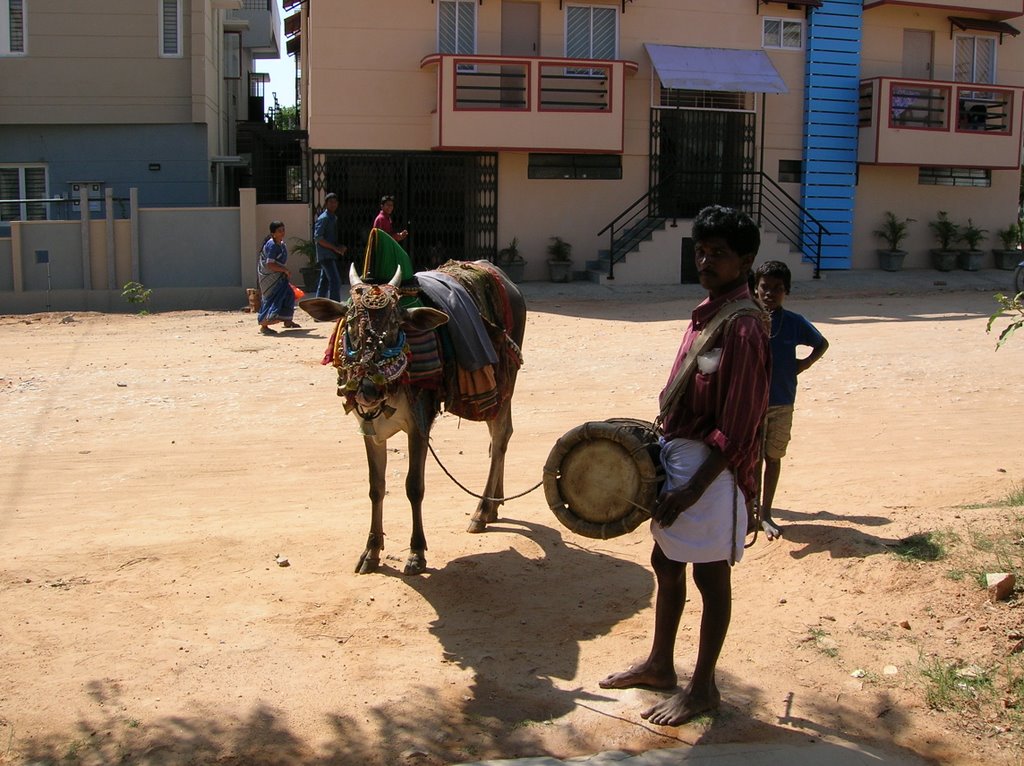
This pair comes to our house on all fridays and on all festive occasions - the man plays his Tavil or sometimes the nadaswaram and the Basava (Bull in Kannada) brightens the day by just being his colourful self.


Wish you a happy Vinayaka chaturti. May all your plans in the coming year be impediment-free and successful!
Usha
The other day I was to pick up some friends on our way to the multiplex to watch Omkara. We had arranged to meet at 9:25 and I had to pick up another lady a few blocks away at 9:30. One of the 9:25 ladies finally arrived at 9:35 and in those 10 minutes I had sweated, fretted and fumed. I cannot handle people taking my time for granted and her delay also meant I would be late to pick up the other person which meant taking her time for granted. The worst part was that this friend who arrived late just got in with a smile and did not even feel the need to apologise and when we made it to the hall, she casually says "we were not late for the show or anything, no?".
I guess it is this cavalier attitude towards appointments that has resulted in the joke about Indian standard time. A friend once said, in India we are attuned to the concept of cosmic time and the belief that we always have another birth to finish the things and hence the cool attitude towards seconds and minutes. My sister who went to Germany told me how things work there: If you fix a meeting for 9 a.m and arrive at 8:55, the room would be empty. At 8:59. they all walk in and at 9, everyone is there!

I think it was my job at the bank and the responsibility of carrying the vault keys which has instilled in me the obsession with being on time. You cannot afford to open the Vault later than 9 a.m as it would result in long customer complaints and disciplinary action. And I also believe that being late for an appointment implies an insult to the other person's schedule. One has to think of the trouble that the other person has taken to arrive at the scheduled hour. Every one has a busy life after all. And from practice I know that all it takes to be punctual is the willingness to do it. It is not too tough to work backwards and factor in possible delays and if it seems unachievable, it is better to fix it for a later time than commit to a time and miss it by an hour.

I even know students who tell me how they walked into the exam hall half an hour late for an exam and I simply cannot understand it. I think if the rules of the examination did not permit the grace time, they would make it on time. And the flippant excuses for the delay are even more irritating - "I got up late", "I was searching for a matching pair of slippers". AARRGGGHHHHHHHH.....

Apparently punctuality is not a virtue among latin Americans either. So in 2003, Ecuador launched a campaign to change the mindset of the people. As the Economist reported:
"Hundreds of institutions ranging from local councils to airlines have signed up to a promise to keep to time. Stragglers are barred from entering meetings. Hotel-style door signs have appeared in offices and schools. On one side, they say “Come in: You're on time'' and on the other “Do not enter: the meeting began on time.'' A local newspaper is publishing a daily list of public officials who turn up late to events."

Time we did something like this in this country. Can we start a Campaign?
Usha
With the intention of making everyone in class participate and express, our French professor has a list of interesting questions. You get to choose the question by giving a number in a range and answer the question that corresponds to the number of your choice.Some are funny, some are scandalous and some really philosophic.It is always interesting to see how some turn the most serious question into something frivolous while others pontificate and philosophise over the simplest question. I got the question:

Would you rather be loved or admired and why?

In the class i got away with a simpler answer to this in order to avoid conjugating too many verbs and searching for the vocabulary. But the question kept coming back to me.

I think good people are loved and successful people are admired. Of course that doesn't mean that you can only be good or successful but either one of them is a sufficient condition to be loved or admired.I cannot straight away think of many people who are loved and admired. In recent times Mother Teresa was an example. Even in the case of Gandhiji, I think the British admired but hated him and the Indians loved and admired him.

We admire people when we feel that they have scaled heights that we ourselves may not yet have or may not be capable of. Admiration comes from a wish to be or to do things like someone else - obviously it follows that these feats are difficult to achieve and require tremendous talent/ hardwork/ perseverence/ bravery etc.Putting someone on a pedestal involves a bit of distancing,they no longer "belong" with you but are "there" a little (or lot) higher up.

We love people when we are easy and comfortable with them, when they are kind and nice and generous, funny and forgiving.We love people when they make us feel we are ok people, when they accept us warts and all. And when we love a person we accept them with all their imperfections and failures.

Being worthy of admiration imposes a great burden on a person; you are not allowed to fail or even slip up. But being loved imposes no such burdens - you can be a bumbling bufoon and yet be loved just for being so.

So now you have one guess on what my choice would have been! And what about you?
Would you rather be loved or admired and why?
Usha
I cannot tell a joke. I start with "let me tell you a joke" and then laugh all the way through the joke, forget most of the details and finally deliver the punchline so flatly that people are still waiting for the joke when I am already laughing and wondering why the others did not get it. Once in college I was given a part the fairy god-mother in a spoof of cinderella and I think I laughed more than the audience and forgot all my lines.Needless to say I was fired.

I admire people who can tell a joke - most people think (like I did for a long time) they can but they are wrong. Telling a joke is not just about saying something funny but it is all about the way you can tell it. There are people who can tell a joke that you have heard before and make you laugh all over again with their style, the manner and the delivery of the punchline. I remember my mother's uncle who was a school teacher who had this gift - we would make him repeat his jokes and everytime it seemed like the first time and different. If you are not gifted with it by nature,it cannot be acquired through training.

I was reading an article which says there are
"Two extremes in joke-telling:
Style No. 1: As tight as a haiku. Not one wasted word. Told with aggressive brutality. Ends with a punch line that ends with the punch word. The last word delivers the joke. Then, bang, it's over."

"The perfect joke in Style No. 1, as told by Henny Youngman, Rodney Dangerfield, Lou Jacobi:
Guy goes to a psychiatrist.
Psychiatrist says, "You're crazy!"
"I want a second opinion!"
"All right, you're ugly!"


"Now for a joke in Style No. 2,"
You can read it here
Then there are others who cannot tell a joke but can kill it like giving away the punchline before the speaker finishes the joke. The worse types ask "Then what happened?" .It helps to upstage someone whom you hate. If you want some tips on doing this to someone who steals the limelight with his/ her funny jokes this article tells you how.

It only seems appropriate that I end this piece with a joke.

Pedro was driving down the street in a sweat because he had an important
meeting and couldn't find a parking spot.
Looking up toward the sky he said
(heheheh, this is funny!...He said... wait wait, I'll get it now, hehehehe...)

Never Mind. I think i will spare you the ordeal.Have a great weekend.
hehehehehe
Usha
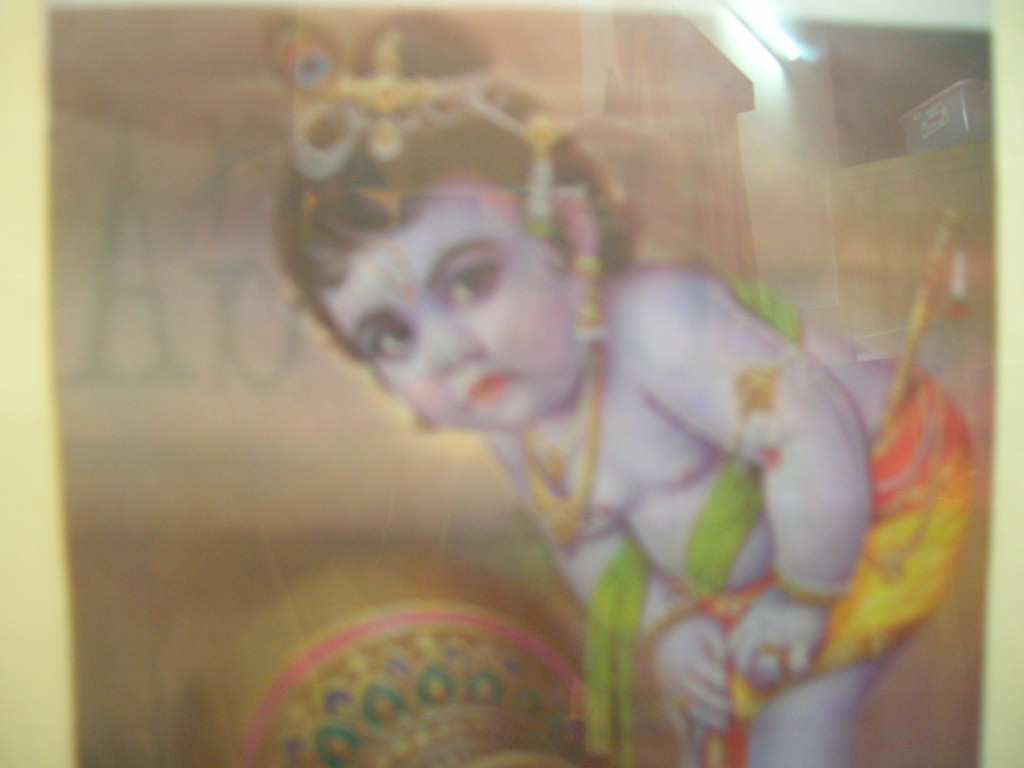
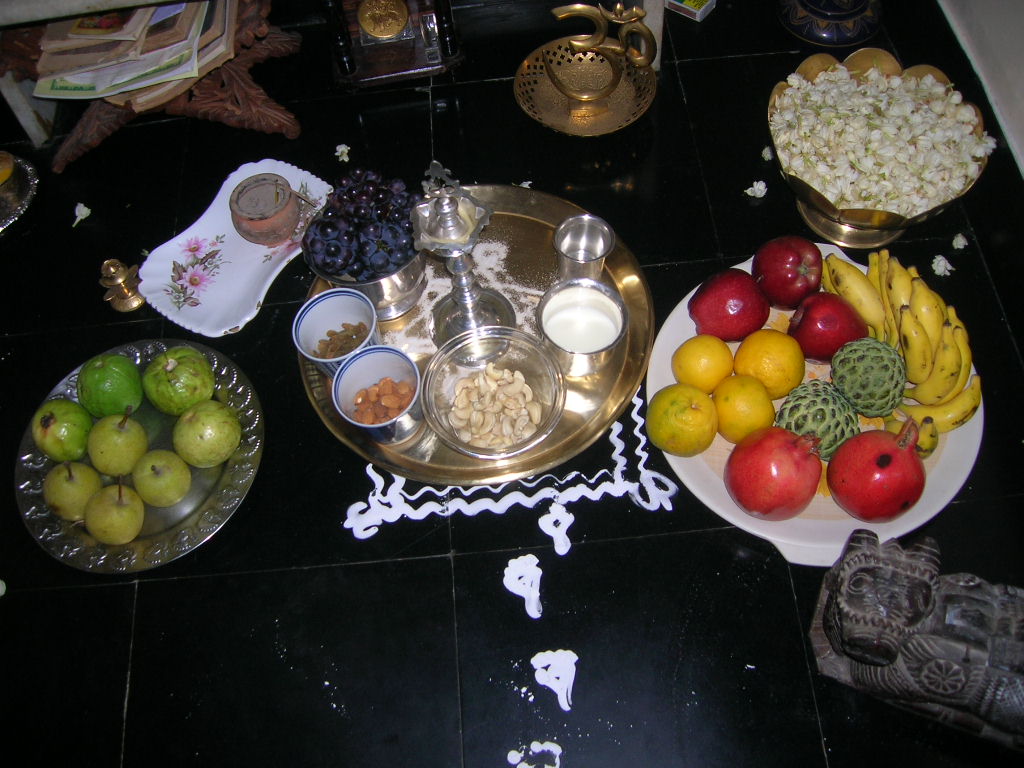
A post on the birthday celebration we had at home today.
The birthday boy:


Bhavayami Gopala Balam ... Mana Sevitham ,
Tat padam chintayeyam sada
kati ghatitha mekhala , khachita mani ghantika
Patala ninadena vibharaja manam
(My mind pays obescience to Krishna (Gopala) the baby and always contemplates on his feet. The baby adorned with a mekala around his waist and other jewels and decorations radiates divine beauty)


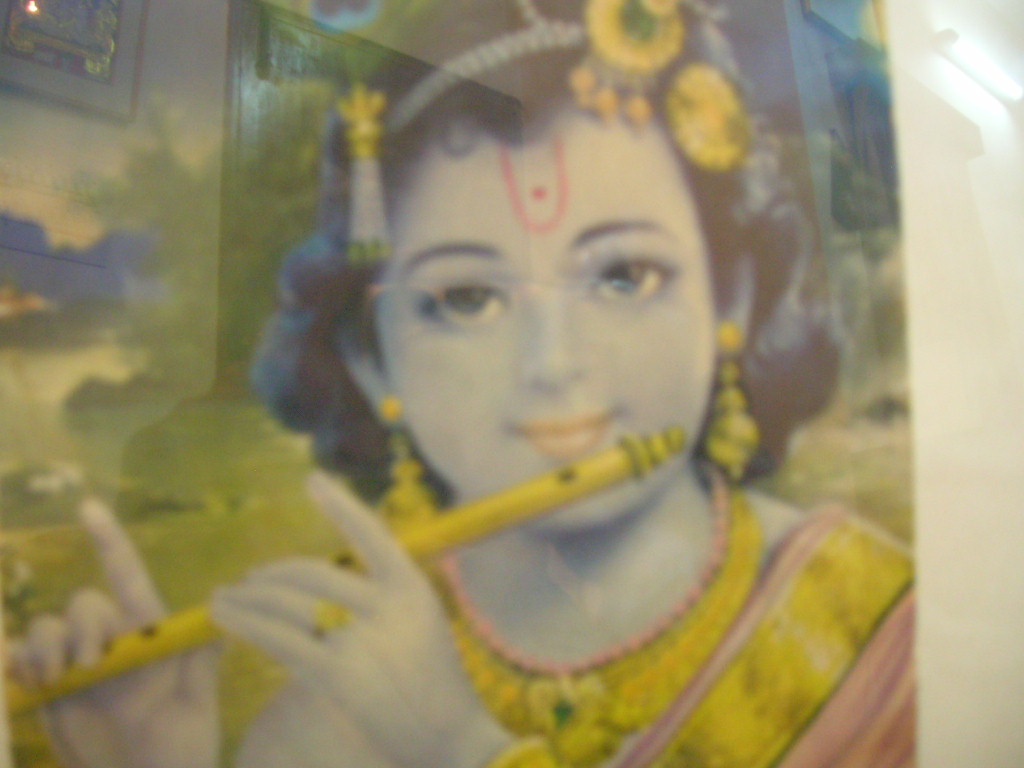
Beautiful child? Wait till you see this!


Madhura madhura vENugIta mOhA madana kusuma sukumAra dEhA

(One who loves the sweet songs played on the flute and one who has a beautiful, soft and youthful form)


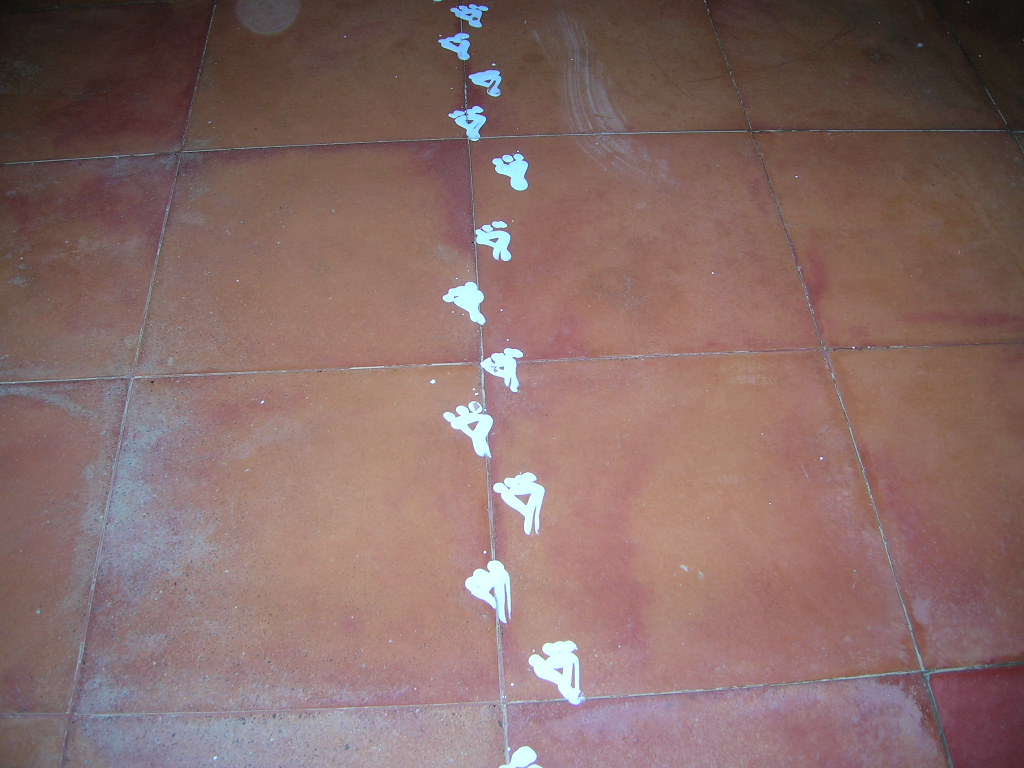
Tiny baby footsteps all over the house marking his presence:


And the menu?


Keraya neeranu kereke chelli
Varava padedavarante kaaneero
Hariya karunadolaada Bhagyava
Hari samaarpane Maadi badhukeero

(We take the water from the river and pour it back to the river as an offering and gain our blessings. Having the good fortune of recieving Hari's grace, let us offer everything to hari and live a happy life)


paritranaya sadhunam
vinasaya ca duskrtam
dharma-samsthapanarthaya
sambhavami yuge yuge


"In order to deliver the pious and to annihilate the miscreants, as well as to reestablish the principles of religion, I advent Myself millennium after millennium."

The world cannot take any more. Please advent yourself NOW!
Come back as Alla, come back as Christ
Come back as Krishna
come back as anyone
Krishna nee begane baro!


Many happy returns to all of you!
Let us pray for peace,brotherhood and love!
Usha
My Cousin dropped by on his way to a friend's wedding. During the course of our conversation he told me that this friend is a Muslim and had been in love with a Hindu girl. After 6 years of courtship they finally decided to part ways and marry persons acceptable to their parents.

The curious aspect is that neither the muslim boy nor the Hindu girl are active practitioners of their religion and even the parents are not very strict in their adherence to customs and rituals. If they could have been good friends without the interference of religion why should it be a problem for a happy marriage? Do people really change after marriage and suddenly become practitioners of their rituals and customs? When people talk about problems that the children of such parents could have, I don't undertand what they mean. Don't parents of all religions bring up their children with the same kind of love and care!

Ultimately isn't marriage about the understanding between two individuals, two human beings more than what name they give to their god or what their prayer rites are like? if their love was really strong, would they not have found it worthwhile to stand up for it and convince their parents? or do the youngsters themselves have different requirements from the person they want to be in "love" with and the person they want to marry? Were the parents being just used as an excuse to get out of an error in judgement and then settle into a more comfortable long term arrangement?

I am not trying to be subversive but I am just trying to understand a societal trend. I cannot dismiss these are cases of immature physical attraction which gradually wore off. These are intelligent students from institutions like the IIT who have the ability to think issues through and the courage to take on the system. So when these young people take shelter behind not wanting to wipe the smile from their parents' faces, I find it tough to accept it at face value; because if such people cannot stand up and fight for what they feel is right, it is a very grim scene. And if they think that falling in love with a person from another religious background is "not right", then it is an even grimmer scene.
Usha
Passerby tagged me and here I go:

A book that changed your life?

The second sex by Simone de Beauvoir..It wasn't actually its content but that was the book my husband gave me when he announced his intention to marry me!

One book you have read more than once?

Most Of P.G.Wodehouse books

One book you would want on a desert island?
Hey I'd want a boat not a book! Ok, if I am getting deserted for a few days (meals included I hope?)I will take the complete works of Shakespeare.

One book that made you laugh?
If you find a woman laughing away reading a book in a public place, it has got to be me. If you want me to name one book it would be "Twisted Tales from Shakespeare" which makes me do that every time read it. Anyone wants a flavour of Richard Armour, mail me with your email ids. I will mail you some.

One book that made you cry?

The diary of Anne frank. Can I also give you the names of the 100 more?

One book you wish had been written?

A manual on how to avoid hurts in human relationships.

One book you wish had never been written?

Kaavya Viswanathan's "How Opal mehta Got kissed etc." Could not read beyond 50 pages!

One book you are currently reading?

Shantharam by Gregory David Roberts

One book you have been meaning to read?

Kalidasa's Meghadootha.

I know that the tag procedure demands that I tag a few more people. So why don't you leave your preferences on any category in the comments?
Usha
$.Connecting with a total stranger in a smile over something funny or cute.
$. Meeting a new friend.
$. Early morning rides with the wind on your face.
$. Listening to an old song and remembering a smell or a face associated with the song.
$. Waking up listening to the rain pouring outside.
$. Nice long bath uninterrupted by the doorbell or telephone.
$. An unexpected call from a long lost friend.
$. Being part of an interesting conversation.
$. Laughing at yourself.
$. Sharing a wonderful dinner and conversation with a few close friends.
$. Laughing without a reason.
$. Finding out that someone considers you "special"
$. Seeing someone you love happy.
$. Finding something of a person you love and smelling his/her perfume.
$. Recollecting a special moment from the past and reliving it with the same intensity.
$. Making up with someone and getting over the hurt.
$. Giving up something that is precious to you to someone who needs it more.
$. Holding a few days' old baby of any species.
$. Long solitary walk on the beach watching the sunset.
$. Moments of silent bonding with people you love.
Usha
There was a discussion on a recent social trend called "polyamour" on Radio canada.Apparently it refers to a group of individuals who live in a kind of open relationship. They claim that there are no issues of jealousy or possessiveness and they are able to live in perfect harmony. It seemed a little bizarre and somewhat civilisationally backward to me but another friend said he could perfectly understand the relationships as monogamy is not a natural tendency for humans.He went on further to say that it required very evolved minds to be in such relationships. I thought about it and understood his point of view but I am still not convinced that it could work all that well given the natural tendency of humans to be jealous - particularly when it is a person one is in love with.

I have always found it difficult to understand how women in olden times put up with bigamy when it was legal. It was usually done for reasons of procreation- if the first wife was not able to produce a child within 5 years of marriage or if there was no male child, the man married again. Both wives enjoyed equal status among the family and the children.Of course there were cases when one was preferred over the and there was plotting and scheming which would have made a great television serial. Financial constraints of being able to maintain two wives acted as a deterrent for many. But royalty had no such constraints and almost every king had many wives which was also a matter of strategy - the kingdom of the in-laws would naturally be allies to the king in case of war. In the Mahabharatha, Krishna sent Arjuna on this allies acquisition binge in anticipation of the war with the result arjuna maried a new princess almost every year.And many of the princesses saw their husband only for one year in their whole life - what a destiny for a princess! or did they mind at all? In a sense polyamour was perhaps invented in India - remember panchali marrying the 5 pandavas who each had other wives?

Perhaps women in those times accepted this as natural for a man for specific reasons as above and so trained themselves not to be possessive or jealous of the other women. Concepts such as fidelity were not made much of and that is precisely why Rama's loyalty to one wife in the Ramayana stands out as a major virtue. I guess if we were to ask women of today fidelity would probably rank as their top expectation from their spouse.

Then why polyamour? Perhaps this is happening in countries where marriage is not being viewed as the most ideal form of relationship between a man and a woman. They do not want to be bound by law or contract but by their emotions and understanding. I guess polyamour is just the next step in this ongoing tendency to break free from the conditions that a traditional married relationship imposes on the couple.

I still think all this will only complicate things. With two people, they say, there are three relationships psychologically. Imagine what would happen with so many people in relationship. But I know who would be happy. Film directors who specialise in love triangles - now they can experiment with other geometric shapes.
And imagine the number of songs possible in such a story- I think there may be a revival of the old musical format!
Usha
Ardra tagged me with a series of questions and here are my responses.

I’m thinking about:
What went through that little girl’s mind at St.Anne’s school when there was panic after a hoax call about a bomb in the school. The photo in the papers captures the terror the child is in the grip of. I am also thinking of what is the right punishment for the perverts who derive pleasure from such pranks.
Why it is so tough for us to just be and let be.
I am also thinking otherwise about why my rajma never tastes as good even when I strictly follow the recipe.

I want to:
be free to do everything that my heart tells me to do.
go to Rome, Paris and Egypt
spend a few months near the Himalayas.

I wish
my mother had lived a few more years
I was as clear in my thinking and knew myself as well when I was 20.
I could spend another day with our gang from school just like old times

I hear:
The waves between my ears every time there is absolute silence outside.

I wonder:
If there is a person in the world who is absolutely contented with their life.
What makes us opt for war and not peace.
for how long I will be missed when I am gone forever.

I regret:
not choosing to be a school teacher.
not having been a rebel in my youth.
not having pursued classical music studies.

I am:
a sentimental fool
incorrigible optimist
terrified of formal parties.

I dance:
to relax
when I am alone
to Govinda’s songs - I simply cannot resist the joy in his dancing

I sing:
When I drive
When I am happy
Mostly old tunes although the current one in my head is lukka chuppi

I cry:

Easily for others and less for myself.
And quite unexpectedly.
Particularly if I see children in trouble.

I’m not always
guided by my head.
easy to understand

I make with my hands:
Birthday cards
food
mostly a lot of mess

I write:
my blog to share and to get clarity on my thoughts and feelings.
mails to my friends to know they are safe and happy and to share the news in our lives.

I confuse:
people’s names and faces - especially film actors
Can never remember the gender of nouns.

I need
to love, to have friends,music, books and enough money for the last two.

And finally
This is a tough exercise if you want to be honest and precise.
I am not sure if anyone else is interested in these details about me but Ardra is, and so here they are.
Usha
Many of us spend the better part of our lives in an elusive search for something - someting which we believe will guarantee us satisfaction with ourselves. While on this pursuit, we even postpone enjoyment of everything else we have which in effect amounts to postponing "living". At the end of the search, perhaps some do find what they are looking for but most are left tired and with the realisation that what they have been looking for never existed in the first place. these are the members of the 99 club.
The 99 club?! yes, read on to see what it is:

"Once upon a time, there lived a King who, despite his luxurious lifestyle, was neither happy nor content.
One day, the King came upon a servant who was singing happily while he worked. This fascinated the King; why was he, the Supreme Ruler of the Land, unhappy and gloomy, while a lowly servant had so much joy. The King asked the servant, "Why are you so happy?"
The man replied, "Your Majesty, I am nothing but a servant, but my family and I don't need too much - just a roof over our heads and warm food to fill our tummies."
The king was not satisfied with that reply. Later in the day, he sought the advice of his most trusted advisor. After hearing the King's woes and the servant's story, the advisor said, "Your Majesty, I believe that the servant has not been made part of The 99 Club."
"The 99 Club? And what exactly is that?" the King inquired.
The advisor replied, "Your Majesty, to truly know what The 99 Club is, place 99 Gold coins in a bag and leave it at this servant's doorstep."
When the servant saw the bag, he took it into his house. When he opened the bag, he let out a great shout of joy... So many gold coins!
He began to count them. After several counts, he was at last convinced that there were 99 coins. He wondered, "What could've happened to that last gold coin? Surely, no one would leave 99 coins! "
He looked everywhere he could, but that final coin was elusive. Finally, exhausted, he decided that he was going to have to work harder than ever to earn that gold coin and complete his collection.
From that day, the servant's life was changed. He was overworked, horribly grumpy, and castigated his family for not helping him make that 100th gold coin. He stopped singing while he worked.
Witnessing this drastic transformation, the King was puzzled. When he sought his advisor's help, the advisor said, "Your Majesty, the servant has now officially joined The 99 Club."
He continued, "The 99 Club is a name given to those people who have enough to be happy but are never contented, because they're always yearning and striving for that extra 1 telling to themselves: Let me get that one final thing and then I will be happy for life."
We can be happy, even with very little in our lives, but the minute we're given something bigger and better, we want even more! We lose our sleep, our happiness, we hurt the people around us; all these as a price for our growing needs and desires. That's what joining The 99 Club is all about."
(Source of story:Unknown)

Henry David Thoreau said " The cost of a thing is the amount of what I call life which is required to be exchanged for it, immediately or in the long run." It is an irony that for many of us the cost of a huge part of our life is the "missing" one coin!
Usha
Was at a supermarket last week when the sales person at a cosmetic brand counter was demonstrating an anti ageing formula to me. She was trying to tell me how within 3 months of usage I could lose wrinkles and look visibly younger. I was amused and asked her how old she thought I was. "40s?" she hazarded so I told her that she was correct and why she thought I should look any different from a person in the 40s at such an exorbitant price.She was puzzled at my simple logic and I am sure she thought I was slightly crazy.

The reluctance among women to give in without a fight to the process of ageing took over the west a few decades ago and now it has spread to India too. At the minimum, almost every woman over 30 colours her hair to cover the grays at least in the cities. Cosmetic surgery is still popular only among the rich and famous and those in the beauty industry and actors. But most city women have been tempted by one or other of the anti wrinkle solutions or anti ageing creams available in the market. Botox treatments and liposuction are not totally unheard of.

Why are people willing to subject themselves to such processes in order to resist looking their age? I understand the need with people in entertainment industry as their appearance ensures longevity of their career.

But why are women in other professions obsessed with looking younger? I think ageing gracefully is more about keeping oneself fit and active as long as possible without feeling weak and dependent. It has less to do with looking like a 30 year old when you are actually 50. Acceptance is an integral part of turning 40 - one has to learn to accept that one no longer has the stamina that one used to have at 20 and 30 and that there is a limit to the kinds of indulgences one can permit oneself. One has to learn to accept a few wrinkles here and there and new gray strands every few months. There is a difference between taking up an arm chair giving up on life and acceptance which is a positive approach to the inevitable process of ageing. It is important to be physically active and self sufficient for as long as one can rather than retiring from ones life at 50. But most people seem to confuse being young at heart with looking young.

I think there is a beauty that shines through a person who ages gracefully accepting the natural changes in her body rather than the constantly surprised look of a person who has had a facelift. It is certainly not possible to reverse something as natural as ageing - the best way to handle it is to wear the wrinkles with dignity. Something which our earlier generations did without even trying.
Usha
I knew they'd find someway to shut me up - this was just too good to go on for 3 years. Unlimited liberty to say all that you want and be read and responded to. Well finally someone decided they had enough and now I cannot see my blog anymore!!And I cannot see anyone else's blog either - guess they didn't want me to start blathering in the comments on others' posts.
I am posting this to see if a new post might somehow bring my blogspot back alive. so here I go.If it doesn't goodbye, thank you and God bless!
Usha
Was in chennai for a niece's wedding. Itacted as an eye opener in many ways. The last wedding I attended was over 18 years ago. In the intervening years I had somehow imagined that people's attitude towards arranging marriages and celebrating weddings had changed a lot in keeping with the changing times. But I learnt a lot to the contrary in the 2 days.

Both the bride and the groom work in the U.S. and this was another reason I had assumed that the rituals would be restricted to the barest minimum. Actually, it turned out to be more elaborate than usual and included some of the events dispensed with in city weddings like the "vilayaadal"or "Nalangu"(which is mostly silly games and funny songs).I suppose staying so far away from Home makes people nostalgic for rituals and one is keener to preserve them than those who live with these on a daily basis. When I expressed this another cousin made a sharp observation that it is more for capturing it all for their video for their friends in the U.S rather than any deeper desire for preservation of anything. Well, whatever.People still do not mind having elaborate marriage ceremonies.

The expenses for the wedding are alarming and yet people want to do it no other way. A close relative gave me a figure of 10 lakhs as the minimum requirement for a "decent" wedding. And there is NO dowry involved - this is the expense for the wedding hall, food, the arrangements for the rituals, the dress and jewellery! When I asked why people did not prefer to have the wedding as a private affair in a temple and then have a reception which might bring down the expenses I was told "why must we do it hush hush when there is nothing to hide. The whole joy is to call everyone you know and have them come and wish the couple." That seems to be a million rupee decision. Still all the expenses are borne only by the bride's side!

Even though a lot of young boys and girls are working abroad, they seem to prefer to let the parents arrange the proposal. I do not know if they actually "prefer" it or it is the parents who want it this way. During the time I was at the wedding, I was approached by at least 3 mothers with girls in their early 20s who asked for my son's horoscope and some others asking me to suggest good girls for their sons. Apparently this is a normal activity at weddings - many alliances get initiated at weddings. They first ask you about yourself and then about your children and if they are impressed they broach the subject of horoscope exchange without wasting any time.

Girls are clear about what they want to do career wise ( engineering, then job at a particular company for 2 years and then M.B.A.) but they do not seem to mind marrying a guy that their parents find for them. There is still a strong preference for arranged marriages in spite of all that one hears on television and in films.

And the biggest revelation of it all was that the "girl seeing" ceremony - that is the visit by the boy and his parents to the girls house to meet the girl and her family once the horoscopes and photos have been matched - is still very much "on". The girl is no longer expected to fall at their feet and seek their blessings and she actually gets to talk alone with the boy for albeit a few minutes and the girl's opinion counts - these are the improvements from old times but still the practice is very much alive. Preethi has written a series of posts in her spot here on her personal experiences in this area. They are detailed and hilarious and when I see them from her prespective, the posts raise a lot of interesting points on how such methods still work in today's environment.

When I voiced my surprise at how nothing seems to have changed in the past 27 years since my own wedding I got the right answer from an aunt who said: "These have been preserved and handed down for the past thousands of years. And what makes you think they would have changed in 27 years?"
Usha
Headlines of newspapers scream day in and day out about the violence of people demanding their homeland or seeking a separate land for themselves. Suicide attacks, killing of innocent civilians, assassinations and verbal violence - wherever you turn the noise is deafening. Among all this bloodshed, there is a quite community of 6 million Tibetans who lost their homeland nearly 60 years ago to the aggression of their neighbour and have been forced to live in exile in other countries. They miss their land, their lifestyle and ther is alot of anger especially among the younger generations who have never seen their home. And yet all this youth energy and anger is controlled and they campaign to mobilise support for their cause. They do not even think of violence as an alternative. Their leader, winner of the Nobel peace prize, His Holiness the Dalai Lama, hopes to find a peaceful solution through negotiations.

A large number of Tibetans have been killed, their culture destroyed through demographic altreration by the settling of chinese in Tibet and reduction of Tibetan population caused by the exodus as well as genocide and sterilisations; their way of life has been destroyed through the destruction of monasteries and their environment denuded of its woods and minerals. A whole nation of people driven out of their homes, watching their home being looted and pulled down by the aggressor while being forced to live in foreign lands as guests.
They hope to go back to their home and to their own way of life some day - and yet they do not seek violence and armed struggle. They choose to fight peacefully.The Dalai Lama believes:
"In today's reality the only way of resolving differences is through dialogue and compromise, through human understanding and humility. We need to appreciate that genuine peace comes about through mutual understanding, respect and trust. Problems within human society should be solved in a humanitarian way, for which non-violence provides the proper approach."
To set an example to the rest of the world that peaceful means can still work and to probably change the language of violence all around the world, all peace loving people MUST raise their voice lending support to the Tibetan struggle for liberation.
A victory for Tibetans would be a victory for humanity, a victory for peace.

We talk about word power and thought power."Pen is mightier than the sword" and if we focus all our thought power, we could move even a stone without touching it. Let us try what we can with our word power. July 6th is "Bloggers for Tibet day" and it is also "World Tibet Day". Please blog for the cause of Tibetans, please blog for what is right, Please blog for peaceful means for solving problems. Please blog to help the Tibetans have their home back.
Usha
Recently a Lt.General in the Indian army came under a lot of negative publicity for his remarks about women in the army. It is possible that he had good reasons for his statement besides being purely male chauvinistic but in today’s time and age, you do not make such statements publicly without explaining or qualifying. A combat role in the army is very hard because of the demands it makes on one’s physique, rough and unfriendly terrains and finally the emotional demands– not something easy for men either but I suppose if there are women willing to enter such roles without claiming any special treatment, they should have the opportunity to do so.

When one sees the quickness with which women today challenge such statements and want to assert their equality everywhere, one wonders why this was not the case even 50 years ago – how did they accept a decidedly inferior role for themselves in life and be content with staying in the shadows. I remember discussing this with a friend’s grandmother – she was a graduate, well read, well-travelled and very insightful. She told us that in those days there was a different kind of equality – the clear demarcation of roles depending on a perception of who was better suited to do had no values attached to the different roles. There was no inferiority associated with home making and child rearing which were left to women while men worked to put the bread on the table. They made all important decisions together as equal partners. Neither felt any threat from the other – so there was no need for enforceable laws and rights as it was the unwritten norm in society.

I remembered this conversation while reading “Almost French” by Sarah Turnbull which is a very interesting and amusing narrative by an Australian living in Paris on the cultural differences. She writes:
"France may be famous for feminists such as jean d’Arc and Simone de Beauvoir but the notion of “feminism” is scorned in this country by both sexes. Despite the French penchant for revolution, reforms for women have occurred through slow evolution, and generally later than other developed countries. Incredibly, French women didn’t get their vote until 19444, more than forty years after laws were passed in Australia and New Zealand and almost three decades after Canada and Britain. Until the mid sixties they had to have their husband’s permission to obtain a passport or even open bank account, and their property and family right s were severely restricted.
It is not that other countries do not have issues to resolve concerning women – take a look at Australia where paid maternity leave is almost non- existent and the number of women in senior management remains negligible. But the situation in France is intriguing.
Attempting to explain the absence of women in French Politics, an Ex Justice minister says:
“The very specific history of France, which excludes women from Political role while granting them a well recognized place in society….has created a unique situation between the sexes,” she writes. “if women have not felt totally inferior, it is because their right to speak out has been consistently recognized., bringing them a certain role and power.”
In other words, if French women have not fought for their rights, it is because they have traditionally been treated with respect. If women haven’t shown anger toward men, it is because in this country there is no simmering male anger toward women either.”

I know this may seem repetitive as we had quite a lively exchange of ideas on similar issues after my recent post on women's issues and it made me think of this further.I think in India the unfavourable tilt in the balance of power happened when they stopped educating women on the assumption that they did not need it for fulfilling their traditional roles. With this, informed decision making automatically became a male domain. And when the job of bread winning meant going out to work and not merely on your farm or by practising the family profession, earning money became superior to the traditionally ‘feminine” roles. Deprived of Education women could not enter this arena and this resulted in opportunities for subjugation of women and women were not equipped enough to counter the overt and covert forms of submission. It took a whole movement to be born and they had to organise themselves and fight for "rights" and "equality" in a concerted fashion. Happily all this has changed in the past 50 years. At least in theory there are laws to ensure equality. But in spite of all the rights and laws in existence, nobody can “make” anyone feel “equal” to another. This has to come from within. Every girl should feel that she is no less than any other person whatever she is told.
Another reason for this post is this excellent post by The Rational Fool here where he talks about the challenges before every girl of today in becoming her own person- the historical and social blocks to be overcome and the determination to march on with a focus to live her life as a person in her own right and not be stereo typed into a traditional female role. I believe every girl must do it not only for herself but to be an example and inspiration for her less informed sisters and for the future generations.
Labels: 8 comments | | edit post
Usha
Children in the U.K. will be asked to work out the speed and distance sums by using examples from football and the speed and the distance of the ball that Beckam kicked to the goal. This is part of the GBP 4 million campaign to make mathematics more interesting for children.
Very interesting!! I am all for any effort that makes these speed sums interesting for children.
I have traumatic memories of speed related sums from my school days that have left me permanently scarred. There were this particular genre of sums where the tap was filling a tank at a certain rate of x litres per second and there was this horrible person who was draining the water at the rate of y litres per second and we had to calculate how much time it would take for the tank of a certain capacity to be filled. Every time I am faced with a situation of water scarcity, I have a desire to seek out these water drainers and decapitate them - for spoilng my arithmetic classes as well as being the single large cause of all the global water problem.

My math teacher had a particular penchant for making our lives miserable with such problems. Another of her favourites was:
The population of town A is 4800 more than town B. If 3100 people move from town B to town A, the population in town A will be 11 times that of town B. Find the original total population of the two towns.
Faced with this problem, some of my wizard colleagues would plunge into the problem and be ready in a minute with the answer and as a bonus huge smiles. While my mind would want more data such as "why were they migrating?" "was there an epidemic?' "in which case, what about the reduction in population because of the people dying?" "What about births during the period of migration?" etc...But since i could not muster enough courage to ask the teacher to furnish all the required information, I scribbled the answer 976 3/4 and was sent out of class for being inattentive and trying to act smart! Our educational system kills all creativity, don't you see?

I think it is important to make a child relate these numbers and calculations to reality to evoke interest and make it seem more than mere numbers and additions and subtractions.
Imagine giving the following problem to a child of today:
You are traveling 40 Km/h over a bridge that is 4260 ft. long. How long does it take to cross the bridge?
Wouldn't a smart child in bangalore immediately wonder about other dependencies such as traffic jams? Isn't unfair to let the child out into the big bad world thinking that distance and speed are the only factors involved in assessing the time required to travel between point A to point B.After all , is it not the primary goal of education to prepare a child for the world?
We need to make sums sound more real and true to life to see the real life application.
Sometimes you wonder if mathematicians are people who are so absorbed in numbers that they forget the human element to life. take this problem for example:
Two trains 200 miles apart are moving toward each other; each one is going at a speed of 50 miles per hour. A fly starting on the front of one of them flies back and forth between them at a rate of 75 miles per hour. It does this until the trains collide and crush the fly to death. What is the total distance the fly has flown?

Excuse me, we are talking of a major collision here causing a few hundred deaths perhaps. Who cares about the distance the fly has flown? Sympathetic though I am to the preservation of the earth's fauna, I think that hyperactive, maniacal freak of a fly deserved to die for running between the trains.Wonder if he caused the collision by distracting the drivers with his constant flight!

P.S.: Hehehe. there , that felt really good! My sweet revenge for all the knuckle raps that I suffered at school for being so numerically challenged.
I actually have great respect for mathematics and mathematicians - no offence intended. But I really used to find some of these sums highly amusing.
Usha
As a nation I think we are not a very demonstrative people particularly of emotions of love and affection.While we may jump and scream during a cricket match and express our joy and anger, when it comes to showing love and affection we tend to underplay and even suppress.Most Europeans and even in America, it is common to greet each other with a peck on the cheek, a hug or a half hug. But in india, most of us shy from being touchy-feely and demonstrative. It is not difficult to understand it as in our culture physical contact was restricted to family - in south India,a brother is not allowed to touch a grown up sister, leave alone hug and plant a kiss. With a lot of people travelling and with the western influence on our life style, things are changing.
One sees a lot of it in the Hindi film fraternity and among the college students. Actually it feels quite good when many of the younger girls in the french class spontaneously greet you with a hug. It does seem therapeutic and may be there is some truth in the famous treatment technique of Munnabhai m.b.b.s. - the jadoo ka jhappi treatment. According to a family therapist Virginia Satir "We need 4 hugs a day for survival. We need 8 hugs a day for maintenance. We need 12 hugs a day for growth!"
Next time you find someone close in a sad or low mood, try giving them a hug and see the difference. If you love someone or care about someone, it is ok to express it - it does not make you weak or vulnerable.
Apparently hug can be an effective neutraliser of anger. Walter Anderson says
"If you're angry at a loved one, hug that person. And mean it. You may not want to hug - which is all the more reason to do so. It's hard to stay angry when someone shows they love you, and that's precisely what happens when we hug each other."
Kids know this instinctively. The moment they sense that you are angry, upset or sad they give you a hug and make you feel better.
This article has some interesting information on the importance of hugs as a therapy.
And next time you meet a friend but did not have the time to buy a gift remember this:
“A hug is the perfect gift; one size fits all, and nobody minds if you exchange it.”
Usha
Anita nair had written a nice article in the New Indian Express on father's day. I always get very interested when people talk about their relationship with their father, the jokes and pranks they shared, their discussions,arguments etc. In our family, we knew our father only through my mother. He hardly spoke to us and if we needed anything mother conveyed it to him and it was either approved or rejected. No further appeal. He was not someone who was ever worried about our academic performance - perhaps because we were all inevitably at the top of the class but i have a nagging feeling that he would have signed our report card without a murmur even if we had got the last rank in class. I do not remember him ever giving us advice or opinion on anything - he might have if we had asked him but we were too scared to talk to him directly. And it was always a joke to me when my mother claimed that I was my father's favorite - i wish he had shown it to me in some ways! It was only after my marriage that I experienced tangibly a father's love through my father in law who treated me more like his own daughter.

With this kind of emotional baggage, I always feel a tug somewhere inside when I come across special father /children bonds in books and films.Needless to say that I have my own set of favourite fictional fathers:

At the very top of the list of course is daddy "Mrs.Doubtfire"- doting and full of fun, a buddy above all- someone who makes you feel "no matter what, I will always be there for you." He could get you in trouble, lots of it but you know he will also get you out of it. A great dad for pre-adoloscents.

Almost rubbing shoulders with daddy doubtfire is the daddy played by Gregory Peck in "To Kill a Mockingbird" - a daddy whom every child would be proud of. A little too perfect? May be, but who's complaining?

Mr.Bennett of Pride and Prejudice is another favourite. He was perhaps a failure in a conventional way in terms of securing a sound financial future for his daughters and that is precisely what makes him more human than the other fictional fathers. He is not a super hero. He is an ordinary father whom you could actually hope to have - well-read,one with whom one can discuss anything under the sun, share a good joke with and one who would support you in any rational decision you make. A great father in your teens and adulthood.

The role of "daddy" played by Anupam Kher in the Hindi film of the same name is another favourite - an immensely talented poet. oozing sentmentality from every pore, weak in many ways but I just love the way he looks at his daughter - as if his world started and ended there.

I love another father's role he played in "Dil Hai ki maanta nahin" - super rich and super crazy. Now that is a fun father who would indulge your every whim and if you are equally crazy, the world can't get better. I particularly loved the last scene when he incites Pooja to elope with Aamir in stead of the rich boy who is about to marry her and the way he gleefully announces after she runs away: "She has a habit of running away and she has done it again!"

The only Father/ daughter duo I could remember from Tamil films is the one in Rajaraja chozhan played by Shivaji Ganeshan and Lakshmi - very interesting interaction between a smart father and daughter. The daughter worships the father and the father adores the daughter but neither could be bothered to make a show of it and have to constantly engage in verbal battle and one-up-manship in witty exchanges. Very interesting portrayal.

Of the ad dads, my favorite would have to be the father in the Nokia cell phone ad which goes "Na Badla woh suraj woh rah, Na badle mere papa." In the one minute you see the special bond between father and son and their expressions are lovely - a father who takes special care to instil the right values in his children and show them the right path ahead and would stay down to earth to insist that the function of a phone is to simply talk to someone!

And finally of course I know for most of you who read this your favourite daddy is your own - So don't wait for a special day to let him know that - Now is always a good time!
Usha
Saw two films in the past few days - both left me thinking about women and their life and psyche just about 100 years ago.

The first was a french film "Camille Claudel" - based on the life of Camille, who was the pupil of Auguste Rodin, the French sculptor who attained immortality through his carving of "le Penseur"(the thinker). She was so talented and inspired in her work that she became his muse, his model and collaborator for some his best works. They had a passionate relationship which ended when she realised he would never leave Rose Beuret,his partner of 20 years. In the subsequent years she created a lot of work which showed her genius and originality but she never got over Rodin and slowly became alcoholic, depressed and paranoid. In her destructive phase she destroyed much of her work and finally had to be confined to an asylum where she lived for 30 years till her death in 1943.
A woman with immense talent, a rebel but destroyed by the her love for a man and his refusal to marry her.So much genius, so gifted but all to no end - what an immense loss to the world of art. What was the reason - love too strong or inability to accept rejection? Did she value herself only in relation to Rodin that she went on a path of destruction wheh he refused to marry her?

The second was "Memoirs of a geisha" - the story of a young girl who is sold by her parents to a okiya or a geisha house , her initial resistance and struggles and gradual transformation into acceptance of her life and its culmination in her becoming the finest geisha in town. It could have easily slipped into a documentary but for the emotional interplays involving jealousy, love and sacrifice. Nice and touching film.

What struck me was the concept of "geisha" - women who were trained in everything beautiful, artistic, gentle and doing and saying things in the right manner- whether it was pouring sake or discussing politics.At a time when wives were excluded from public life, geisha women were employed to be hostesses at social gatherings as they were trained in the skills that symbolised society's illusion of feminine perfection. Obviously such perfection can never been attained in a "real" relationship as with a man and his wife. The reality of day to day living tends to complicate life and brings out the rougher and ruder side of men and the nagging, sulking and meaner side from the woman. Real life is after all not perfect. That is where the Geisha's came in - as a periodic escape into a make-believe world where everything was beautiful, gentle and perfect. An escape into a fantasy world which cost a packet to the man in terms of maintaining the Geisha and for the woman , the cost was that she could never have the status of a wife. A classic case of commodification of women and yet a lot of women chose the profession and took pride in being the best Geisha.

Two types of women - exact opposites in terms of personality! Of course it is true that neither type of women represented the "typical" or average woman of their age. But until very recently women were expected to possess certain attributes as defined by a man's conception of what was "desirable" in a woman and this played a large role in their upbringing. "Rejection" affected them.
What is comforting is that most of the young women of today can relate to neither type of women - shows the distance we have covered in terms of advancement of women. Men and marriage have ceased to be the point of reference for what they choose to do with their life. Their life is much larger than these.
Or is it?
Usha
The Income Tax forms to be submitted in the coming years will collect information on the spending details of the assessees. When I read this I wondered if the Finance Minister was trying to understand the soul of the assesees as I had read somewhere:
"How you make your money is unimportant;how you spend it reveals your soul."
I suppose the FM today is such a harried man that he has no such desires but yes, the spending habits of a person or family speak a lot about them. The FM himself is a personally wealthy man with simple and refined tastes and then we have men like Narayanamoorthy on whom their enormous fortune sits lightly. Makes you realise that beyond what you can spend in a lifetime, your bank balance is just a number.
As one looks around and sees the salaries offered for fresh engineers and MBAs you realise that the problem for many today is not "how to Make money" but "how to spend it well."I guess that is where the lifestyle magazines come to one's aid - showcasing exclusive products designed to announce your "arrival" to the world. Watches costing lakhs, designer jewellery, cars oozing machohood and diamonds enhancing one's self esteem.
I suppose the first impulse we all have when we get our financial independence is to splurge on things we have always wanted but not allowed to have. Most of the time these attractions lose their charm once we have the ability to acquire them anytime. So it would seem that the trick would be to set one's desires so high that you would always be a little short of the ability to have it, and this will keep you stay motivated to make more money. I know a few friends who support a lot of causes and this give them the motivation to earn - the desire to help the needy. But on the average, I suppose most people make money to have comfort, security in old age, a certain level of luxury and indulgence and their spending patterns reveal these motivations which revolve more around themselves and their family than any cause or person beyond. Not a bad motivation to have - at least they are not a burden to anyone. What I cannot understand is people who spend so much time and energy making money and having no time or interests to spend it. And then there are these others who make money in corrupt ways that spending it or even keeping it becomes a problem - they have to create secret storages in their house floors or their children use currency notes to smoke cocaine.
I suppose money well spent is an indicator of a life well-spent.
But I think the problem with running after making money is the question :"how much is enough?" Tough question. But I think for me , "enough" would be when I can give my children nutritious food and good education,buy the books and music I want,not have to think twice about inviting someone to share my meals,indulging in something silly once in a while, and being able to lead my simple life independently without becoming a burden to anyone till the end.
Isn't that enough?
Usha
Traffic in Bangalore tops the list of my pet peeves. I can claim to have some experience on the subject having had the experience of driving 28km each way from IIM to peenya every single working day for 3 years and that practically covers a diagonal sweep from southeast to northwest ends of bangalore (in the early 90s - now bangalore has stretched beyond in both directions)
And I have spent another 20 years driving around town to different workplaces and so I can speak about it with some authority. But one can sum up Bangalore traffic today in one word:CRAZY! and add a statutory warning: KEEP AWAY!
So it was highly cathartic to read a hilarious article forwarded by Ramkumar on the condition of Indian traffic and pretty spot on. Thanks Ram. I agree ,there is no calamity so great that you cannot laugh about it!
This hilarious article was written by a Dutchman who spent two years in Bangalore, India, as a visiting expert
Driving in Bangalore / India
"For the benefit of every Tom, Dick and Harry visiting India and daring to drive on Indian roads, I am offering a few hints for survival. They are applicable to every place in India except Bihar, where life outside a vehicle is only marginally safer.
Indian road rules broadly operate within the domain of karma where you do your best, and leave the results to your insurance company.
The hints are as follows: Do we drive on the left or right of the road? The answer is "both". Basically you start on the left of the road, unless it is occupied. In that case, go to the right, unless that is also occupied. Then proceed by occupying the next available gap, as in chess. Just trust your instincts, ascertain the direction, and proceed. Adherence to road rules leads to much misery and occasional fatality. Most drivers don't drive, but just aim their vehicles in the generally intended direction.
Don't you get discouraged or underestimate yourself except for a belief in reincarnation; the other drivers are not in any better position.
Don't stop at pedestrian crossings just because some fool wants to cross the road. You may do so only if you enjoy being bumped in the back.
Pedestrians have been strictly instructed to cross only when traffic is moving slowly or has come to a dead stop because some minister is in town.
Still some idiot may try to wade across, but then, let us not talk ill of the dead.
Blowing your horn is not a sign of protest as in some countries. We horn to express joy, resentment, frustration, romance and bare lust (two brisk blasts), or just mobilize a dozing cow in the middle of the bazaar.
Keep informative books in the glove compartment. You may read them during traffic jams, while awaiting the chief minister's motorcade, or waiting for the rainwater to recede when over ground traffic meets underground drainage.
Occasionally you might see what looks like a UFO with blinking colored lights and weird sounds emanating from within. This is an illuminated bus, full of happy pilgrims singing bhajans. These pilgrims go at breakneck speed, seeking contact with the Almighty, often meeting with success.
Auto Rickshaw (Baby Taxi): The result of a collision between a rickshaw and an automobile, this three-wheeled vehicle works on an external combustion engine that runs on a mixture of kerosene oil and creosote.This triangular vehicle carries iron rods, gas cylinders or passengers three times its weight and dimension, at an unspecified fare. After careful geometric calculations, children are folded and packed into these auto rickshaws until some children in the periphery are not in contact with the vehicle at all. Then their school bags are pushed into the microscopic gaps all round so those minor collisions with other vehicles on the road cause no permanent damage. Of course, the peripheral children are charged half the fare and also learn Newton's laws of motion enroute to school.
Auto-rickshaw drivers follow the road rules depicted in the film BenHur, and are licensed to irritate.
Mopeds: The moped looks like an oil tin on wheels and makes noise like an electric shaver. It runs 30 miles on a teaspoon of petrol and travels at break-bottom speed. As the sides of the road are too rough for a ride, the moped drivers tend to drive in the middle of the road; they would rather drive under heavier vehicles instead of around them and are often "mopped" off the tarmac.
Leaning Tower of Passes: Most bus passengers are given free passes and during rush hours, there is absolute mayhem. There are passengers hanging off other passengers, who in turn hang off the railings and the overloaded bus leans dangerously, defying laws of gravity but obeying laws of surface tension. As drivers get paid for overload (so many Rupees per kg of passenger), no questions are ever asked. Steer clear of these buses by a width of three passengers.
One-way Street: These boards are put up by traffic people to add jest in their otherwise drab lives. Don't stick to the literal meaning and proceed in one direction. In metaphysical terms, it means that you cannot proceed in two directions at once. So drive as you like, in reverse throughout, if you are the fussy type.
Least I sound hypercritical, I must add a positive point also. Rash and fast driving in residential areas has been prevented by providing a "speed breaker"; two for each house. This mound, incidentally, covers the water and drainage pipes for that residence and is left untarred for easy identification by the corporation authorities, should they want to recover the pipe for year-end accounting.

Night driving on Indian roads can be an exhilarating experience for those with the mental make up of Genghis Khan. In a way, it is like playing Russian roulette, because you do not know who amongst the drivers is loaded. What looks like premature dawn on the horizon turns out to be a truck attempting a speed record. On encountering it, just pull partly into the field adjoining the road until the phenomenon passes.

Our roads do not have shoulders, but occasional boulders. Do not blink your lights expecting reciprocation. The only dim thing in the truck is the driver, and with the peg of illicit arrack (alcohol) he has had at the last stop, his total cerebral functions add up to little more than a naught. Truck drivers are the James Bonds of India, and are licensed
to kill. Often you may encounter a single powerful beam of light about six feet above the ground. This is not a super motorbike, but a truck approaching you with a single light on, usually the left one. It could be the right one, but never get too close to investigate. You may prove your point posthumously."
Usha
If you were born after the 70s and lived in one of the cities all your life, it is very likely that you do not know what Pallankuzhi is. But those older, especially from the smaller towns of South India may have spent many summer afternoons in endless rounds of this game. Remember this?


The kit for the game was no more than this wooden plank with 14 holes and 144 to 170 cowrie shells ( sozhi).
The game did involve some calculations while each player tried his best to capture all the sozhis and defeat the other players.It was a little like life itself - At the start of the game eveyone gets the same number of sozhis and what you made of it later was purely left to yourself and chance.Sometimes you were nearly bankrupt and then ended with a windfall ( in the form of getting access to the central hole called the Kasi) However careful you were in your calculations,chance did play a part and you ended up losing. For example the first player had some advantages in some settings and when a player did not have enough for all the holes on his side, the holes he chose to leave empty had a role to play. There were variations of the game depending on the age groups differing in degrees of difficulty.

The above is a 60 year old pallankuzhi plank with me and when my fingers need some exercise I do play solitaire version of it. My grandmother used to play against herself and every hand she played she played to win.And I am sure it was a good exercise for her hands and mind and perhaps a defense against Alzheimer's and the like.She lived to be 90, alert and active.

So you can imagine my delight when I saw THIS
"warmed the cockles of my heart!" as Bertram Wooster would have said. And indeed it did exactly that. I am reproducing it here for your convenience:

"A Game of Warri"


"Harbhajan Singh wracks his brains over a game of Warri, a pastime that the locals introduce him to. Warri is played in India as well – it's known as Pallanguzhi in Tamil – but, going by the mystified looks, none of the Indians seemed to have heard of it."

"If you have mastered Warri, you earn the title of "professor". One such professor decided to give Harbhajan a lesson, teaching him the intricacies of the game. A Warri board comprises twelve large pockets, into which 48 beads are filled equally. The player who begins empties one of the pits that belongs to him and distributes the seeds - one for each pit in a clockwise direction. He continues the process by emptying the pit next to where he ends the first set of seeds. He carries on the process until the end, when if he finds more than one empty pit, he gives up the turn to the other player. If he finds one empty pit next to the pit where he ended, then he captures all the seeds gathered on the right side of the empty pit. The player who captures the most seeds ends up the winner."

"Quick counting of the beads and judgement of the number of pockets to be filled requires one to be very attentive. It also requires some rapid mental calculations. Harbhajan does well, plays a few smart moves and thrills "professor" with his learning curve. Inevitably he loses, but the margin (25 to 23) tells you how close it got. "Professor" challenges him for one more round. Harbhajan, though, has a valid excuse: "I need to go out to bat, wickets are falling quickly."
Posted by Siddhartha Vaidyanathan
http://blogs.cricinfo.com/tourdiaries/archives/2006/06/a_game_of_warri.php#more

Pallankuzhi-warri championship trophy - any sponsors???